
If you were born after the Cold War, studying Vietnam can feel disorienting. The language used to justify it sounds abstract now. Containment. Credibility. Dominoes. Yet the consequences were painfully concrete: 58,220 Americans killed, and Vietnamese losses that reached into the millions.
The lingering question is not simply why the United States entered the war. It is whether people inside the national security system recognized early that the conflict was structurally resistant to the kind of victory Americans traditionally expect from war.
The record does not show a memo stamped “unwinnable.” That is not how intelligence agencies operate. What it does show is something more revealing: repeated recognition of deep structural weaknesses, alongside a political process that escalated anyway.
The way they framed it mattered.
Vietnam was not discussed primarily as a complex post-colonial civil conflict with nationalist roots. It was framed as a test of American resolve in a global ideological struggle. Once a war becomes a credibility test, backing away becomes politically dangerous. The question shifts from “Can this be won?” to “What happens if we look weak?”
That shift changes everything.
By the early 1960s, CIA analysts and other intelligence and policy staff were acutely aware of what was happening on the ground. They were watching a South Vietnamese government struggle for legitimacy, cycle through instability, and rely heavily on U.S. backing to survive. They were also watching an insurgency that was not simply directed from Hanoi, but embedded in rural communities where local grievances fueled recruitment.
That distinction was not academic.
If the conflict was primarily nationalist and political, then increasing American firepower would not solve the core problem. You can destroy infrastructure. You can eliminate fighters. But you cannot bomb a population into believing in a government it does not trust.
Across internal assessments, several themes surfaced repeatedly. South Vietnam’s political foundations were fragile. The insurgency had rural support. Bombing campaigns were unlikely to break North Vietnam’s resolve. Military pressure alone would not guarantee legitimacy for the South.
At the same time, U.S. military leadership pursued a strategy centered on wearing the enemy down. The assumption was straightforward: if enough opposing fighters were killed, the insurgency would eventually collapse from sheer losses.
This “wear them down” approach treated the conflict like a conventional war between standing armies. Vietnam was not functioning that way. Insurgencies replenish themselves through ideology, identity, and political grievance. Killing fighters does not necessarily extinguish the conditions that produce them.
By the mid-to-late 1960s, this tension surfaced in a bureaucratic fight over enemy troop estimates. CIA analysts believed the Viet Cong and North Vietnamese forces were larger than publicly acknowledged. Military officials resisted higher numbers that would undermine claims that the enemy was steadily weakening.
This was not merely a statistical dispute. It was a narrative conflict. If the enemy was larger and more resilient than official briefings suggested, then public confidence in progress would erode.
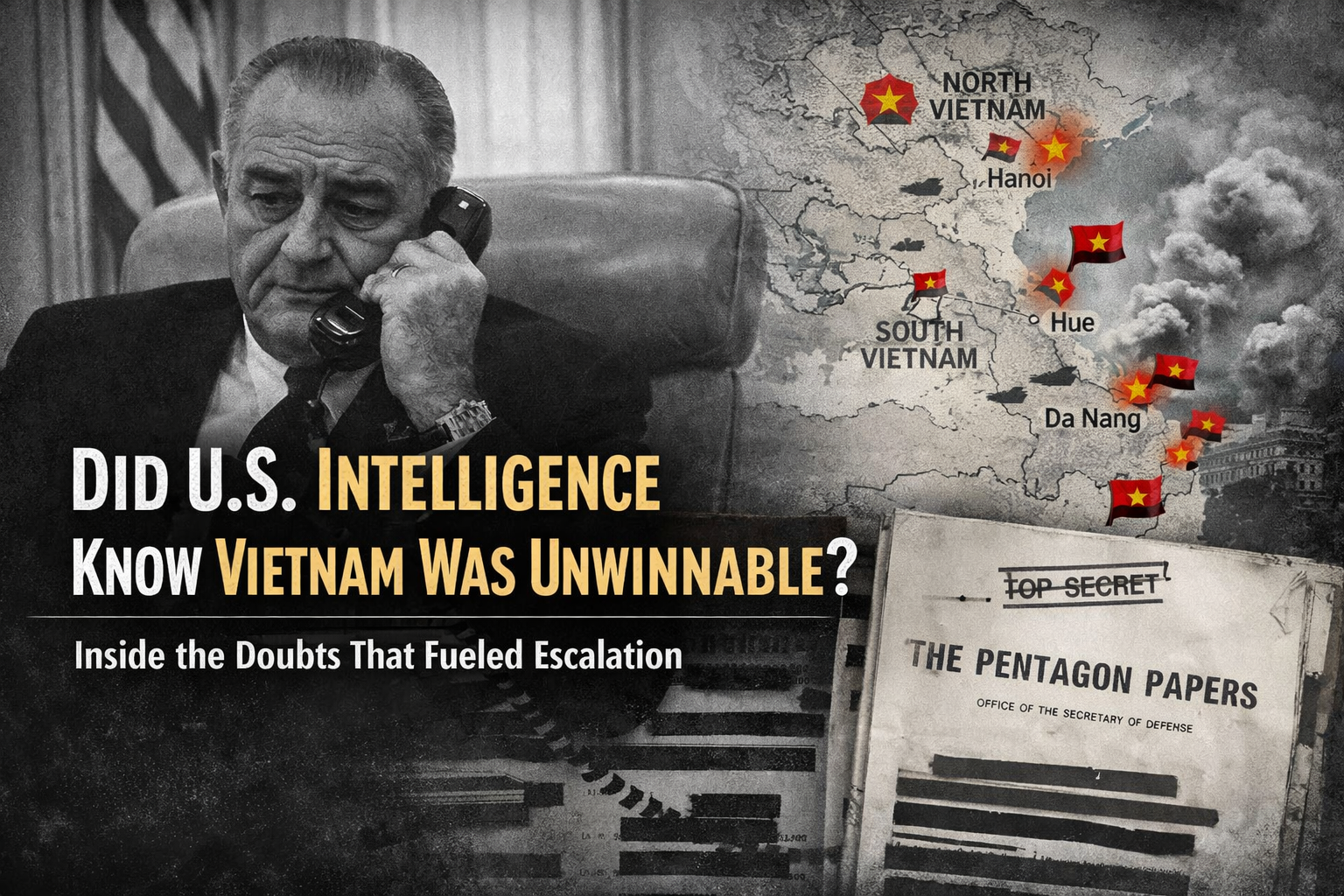
The most comprehensive window into internal doubt came with the Pentagon Papers, a classified Department of Defense study commissioned in 1967 by Secretary of Defense Robert McNamara. The study documented years of internal deliberations and revealed something striking: officials were often more uncertain and more skeptical in private than in public.
The documents showed awareness of South Vietnam’s instability. They reflected doubts about the effectiveness of bombing campaigns. They revealed that credibility, not clear battlefield victory, increasingly shaped strategic reasoning.
When the objective quietly shifts from “win” to “avoid losing,” policy incentives change. Continuing the war can become a way to postpone political consequences, even if decisive success remains elusive.
In October 1963, President John F. Kennedy approved National Security Action Memorandum 263, commonly referred to as NSAM 263. It was a formal directive outlining U.S. policy in Vietnam and called for the withdrawal of 1,000 U.S. military personnel by the end of that year while maintaining overall support for South Vietnam.
After Kennedy’s assassination, President Lyndon B. Johnson approved National Security Action Memorandum 273 in November 1963, reaffirming core objectives while reassessing strategy. What followed was a change in scale. Troop levels rose dramatically over the next several years.
Johnson’s private recordings reveal a president expressing doubt even as escalation accelerated. In May 1964, he told National Security Adviser McGeorge Bundy that he did not think the fight was worth it and doubted the United States could extricate itself without damage. That was not the language of certainty. It was the language of political entrapment.
By January 1968, during Tết Nguyên Đán, the Vietnamese Lunar New Year, North Vietnamese and Viet Cong forces launched coordinated attacks across South Vietnam. What became known as the Tet Offensive did not produce a military defeat for U.S. forces, but it shattered public confidence in official claims that victory was near.
For many Americans, Tet exposed a widening credibility gap between optimistic statements and battlefield reality. For analysts who had long warned about enemy resilience and the limits of conventional metrics, it confirmed that the conflict was far more durable than publicly acknowledged.
So did intelligence agencies know the war was unwinnable early on?
They documented structural weaknesses that made decisive victory unlikely without extraordinary cost. They identified political fragility in South Vietnam. They questioned the effectiveness of bombing. They warned that measuring success through enemy body counts distorted the nature of the conflict.
They did not issue a dramatic declaration of inevitable failure. But the implications of their assessments were clear enough to warrant caution.
Vietnam remains instructive because it shows how systems behave under reputational pressure. Intelligence can illuminate risk. It cannot force restraint. Political leaders must weigh uncertainty against domestic fear of appearing weak, alliance commitments, and global signaling.
In Vietnam, escalation outpaced skepticism.
The tragedy was not that no one saw the limits. It was that acknowledging those limits carried political consequences leaders were unwilling to absorb.
Vietnam was not sustained in blindness.
It was sustained in hesitation.
Sources
National Archives and Records Administration. Pentagon Papers: The Defense Department History of United States Decisionmaking on Vietnam.
https://www.archives.gov/research/pentagon-papers
U.S. Department of State, Office of the Historian. National Security Action Memorandum 263 (Oct. 11, 1963).
https://history.state.gov/historicaldocuments/frus1961-63v04/d194
U.S. Department of State, Office of the Historian. National Security Action Memorandum 273 (Nov. 26, 1963).
https://history.state.gov/historicaldocuments/frus1961-63v04/d331
U.S. Department of State, Office of the Historian. Memorandum of Conversation, President Johnson and McGeorge Bundy, May 27, 1964.
https://history.state.gov/historicaldocuments/frus1964-68v27/d53
University of Virginia, Presidential Recordings Program. Johnson–Bundy Conversation Archive.
https://prde.upress.virginia.edu/
Central Intelligence Agency, FOIA Electronic Reading Room. Vietnam War Documents and Intelligence Assessments.
https://www.cia.gov/readingroom/




Leave a Reply to AshesCancel reply