
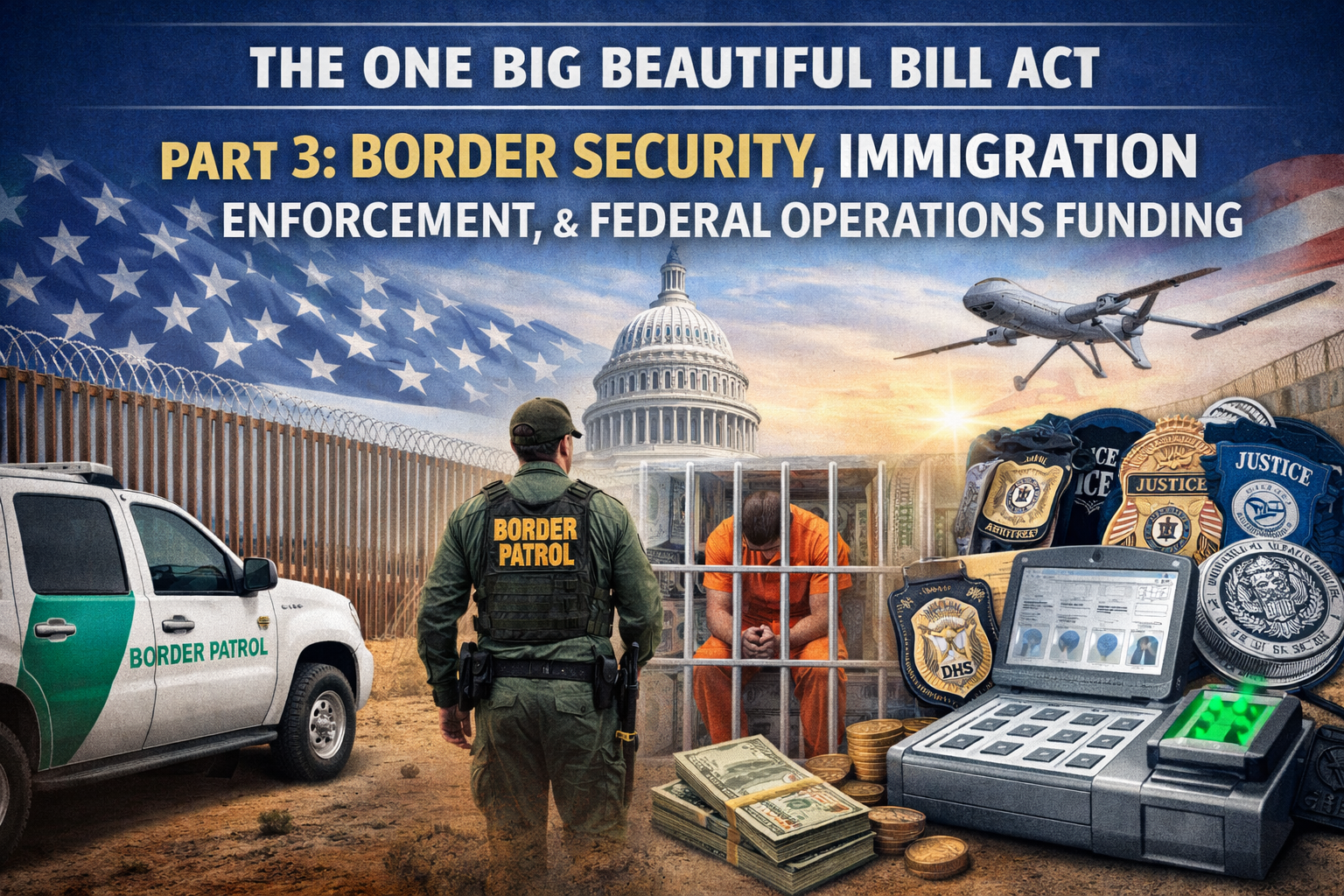
“The Big Beautiful Bill Act” (Public Law 119-21)
Part 3 examines the border security and immigration-related provisions contained in Public Law 119-21 (H.R. 1, 119th Congress). These provisions are primarily structured through appropriations, operational directives, and statutory adjustments affecting federal enforcement agencies.
Unlike Parts 1 and 2, which modify eligibility formulas and benefit structures, this section focuses on federal capacity (personnel, infrastructure, detention, and processing systems).
All descriptions reflect the enacted statute and available federal summaries at the time of publication. Implementation details will depend on agency rulemaking, procurement timelines, and future appropriations adjustments.
Border Infrastructure and Physical Security
Relevant provisions authorize expanded funding for physical border infrastructure and operational environments along designated sectors.
These provisions typically operate through appropriations tied to Department of Homeland Security components, including U.S. Customs and Border Protection.
Funding supports:
• Construction or reinforcement of physical barriers in specified sectors
• Development of access roads to improve patrol mobility
• Installation of lighting systems for nighttime operations
• Expansion of forward operating bases and staging facilities
These are not blanket authorizations across all border areas. Implementation depends on DHS sector prioritization, environmental review requirements, and contracting timelines.
Surveillance, Detection, and Monitoring Systems
The law allocates funding for expanded surveillance capability, which functions alongside or in place of physical barriers.
Authorized systems include:
• Remote video surveillance systems
• Ground-based sensor networks (motion, seismic, thermal detection)
• Aerial monitoring platforms (including unmanned systems)
• Integrated data systems used for situational awareness
These systems are intended to increase detection coverage in areas where terrain or jurisdictional constraints limit physical infrastructure.
Operationally, these tools feed into centralized monitoring environments used by border enforcement agencies to track activity and deploy personnel.
Personnel Expansion and Staffing Authority
Public Law 119-21 authorizes expanded hiring and staffing capacity across immigration enforcement agencies.
This includes:
• U.S. Border Patrol agents
• Customs officers at ports of entry
• Immigration and Customs Enforcement personnel
Funding supports:
• Recruitment
• Training programs
• Equipment and field deployment resources
Personnel expansion is not immediate. Hiring pipelines, training capacity, and facility constraints mean that staffing increases occur over multiple fiscal cycles.
Immigration Detention Capacity
The law includes appropriations to expand detention capacity used in immigration enforcement.
This includes:
• Expansion of existing detention facilities
• Increased contracted bed space
• Operational funding for facility management
Detention capacity is tied to enforcement throughput. Increased enforcement activity requires corresponding capacity to detain individuals during immigration proceedings or removal processes.
The statute does not change detention standards directly. It expands the system’s ability to hold individuals within existing legal frameworks.
Immigration Court and Case Processing Systems
Public Law 119-21 includes funding directed toward immigration case processing infrastructure.
This affects:
• Immigration courts (under the Department of Justice)
• Administrative support systems
• Case backlog management
Funding supports:
• Additional immigration judges and staff
• Case management systems
• Processing infrastructure
These provisions are intended to increase adjudication capacity, which has been a limiting factor in immigration case timelines.
Processing capacity is a separate constraint from enforcement capacity. This section attempts to address that imbalance.
Biometric Identification and Data Systems
The law authorizes expanded use of biometric and data-driven systems in immigration enforcement.
These systems include:
• Fingerprint-based identification systems
• Facial recognition technologies
• Cross-agency data sharing platforms
• Case tracking and identity verification databases
These tools are used for:
• Identity verification
• Entry and exit tracking
• Enforcement coordination across agencies
Implementation depends on agency procurement, integration with existing systems, and regulatory compliance.
Interagency Coordination and Data Sharing
Several provisions support improved coordination between federal agencies involved in immigration enforcement.
Agencies include:
• Department of Homeland Security
• Department of Justice
• Immigration courts (EOIR)
Coordination mechanisms may involve:
• Shared databases
• Standardized reporting systems
• Interagency data exchange protocols
These provisions are designed to reduce fragmentation between enforcement and adjudication systems.
Funding Structure and Appropriations Mechanism
Unlike SNAP and Medicaid (which operate through statutory eligibility rules), these provisions are primarily implemented through appropriations.
This means:
• Funding is allocated to agencies
• Agencies determine operational deployment
• Implementation depends on contracting, hiring, and procurement timelines
As a result, effects are not immediate or uniform.
The law provides authority and funding. Agencies determine execution.
Implementation Timeline
Fiscal Year 2026
Initial allocation of funds and program planning.
Fiscal Year 2027
Personnel hiring expansion and infrastructure project initiation.
Fiscal Year 2028 and beyond
Technology deployment, facility expansion, and operational scaling.
Actual timelines vary depending on:
• Construction timelines
• Hiring capacity
• Contracting processes
• Agency prioritization decisions
What These Provisions Change
The border and immigration provisions in Public Law 119-21 primarily expand operational capacity rather than redefine legal eligibility categories.
Key changes include:
• Increased enforcement staffing
• Expanded detention capacity
• Investment in surveillance and monitoring systems
• Increased funding for immigration case processing
• Expanded use of biometric and data systems
These changes affect how immigration enforcement operates at a systems level rather than how individuals qualify for benefits.
Sources
Public Law 119-21 (H.R. 1, 119th Congress), enacted text, available at Congress.gov.
Congressional Research Service (CRS), immigration and border enforcement legislative summaries.
U.S. Department of Homeland Security (DHS), operational and policy documentation.
Executive Office for Immigration Review (EOIR), court system structure and processing materials.
Congressional appropriations and budget materials related to Public Law 119-21.
Part 3 examines the border security and immigration-related provisions contained in Public Law 119-21 (H.R. 1, 119th Congress). These provisions are primarily structured through appropriations, operational directives, and statutory adjustments affecting federal enforcement agencies.
Unlike Parts 1 and 2, which modify eligibility formulas and benefit structures, this section focuses on federal capacity (personnel, infrastructure, detention, and processing systems).
All descriptions reflect the enacted statute and available federal summaries at the time of publication. Implementation details will depend on agency rulemaking, procurement timelines, and future appropriations adjustments.
Border Infrastructure and Physical Security
Relevant provisions authorize expanded funding for physical border infrastructure and operational environments along designated sectors.
These provisions typically operate through appropriations tied to Department of Homeland Security components, including U.S. Customs and Border Protection.
Funding supports:
• Construction or reinforcement of physical barriers in specified sectors
• Development of access roads to improve patrol mobility
• Installation of lighting systems for nighttime operations
• Expansion of forward operating bases and staging facilities
These are not blanket authorizations across all border areas. Implementation depends on DHS sector prioritization, environmental review requirements, and contracting timelines.
Surveillance, Detection, and Monitoring Systems
The law allocates funding for expanded surveillance capability, which functions alongside or in place of physical barriers.
Authorized systems include:
• Remote video surveillance systems
• Ground-based sensor networks (motion, seismic, thermal detection)
• Aerial monitoring platforms (including unmanned systems)
• Integrated data systems used for situational awareness
These systems are intended to increase detection coverage in areas where terrain or jurisdictional constraints limit physical infrastructure.
Operationally, these tools feed into centralized monitoring environments used by border enforcement agencies to track activity and deploy personnel.
Personnel Expansion and Staffing Authority
Public Law 119-21 authorizes expanded hiring and staffing capacity across immigration enforcement agencies.
This includes:
• U.S. Border Patrol agents
• Customs officers at ports of entry
• Immigration and Customs Enforcement personnel
Funding supports:
• Recruitment
• Training programs
• Equipment and field deployment resources
Personnel expansion is not immediate. Hiring pipelines, training capacity, and facility constraints mean that staffing increases occur over multiple fiscal cycles.
Immigration Detention Capacity
The law includes appropriations to expand detention capacity used in immigration enforcement.
This includes:
• Expansion of existing detention facilities
• Increased contracted bed space
• Operational funding for facility management
Detention capacity is tied to enforcement throughput. Increased enforcement activity requires corresponding capacity to detain individuals during immigration proceedings or removal processes.
The statute does not change detention standards directly. It expands the system’s ability to hold individuals within existing legal frameworks.
Immigration Court and Case Processing Systems
Public Law 119-21 includes funding directed toward immigration case processing infrastructure.
This affects:
• Immigration courts (under the Department of Justice)
• Administrative support systems
• Case backlog management
Funding supports:
• Additional immigration judges and staff
• Case management systems
• Processing infrastructure
These provisions are intended to increase adjudication capacity, which has been a limiting factor in immigration case timelines.
Processing capacity is a separate constraint from enforcement capacity. This section attempts to address that imbalance.
Biometric Identification and Data Systems
The law authorizes expanded use of biometric and data-driven systems in immigration enforcement.
These systems include:
• Fingerprint-based identification systems
• Facial recognition technologies
• Cross-agency data sharing platforms
• Case tracking and identity verification databases
These tools are used for:
• Identity verification
• Entry and exit tracking
• Enforcement coordination across agencies
Implementation depends on agency procurement, integration with existing systems, and regulatory compliance.
Interagency Coordination and Data Sharing
Several provisions support improved coordination between federal agencies involved in immigration enforcement.
Agencies include:
• Department of Homeland Security
• Department of Justice
• Immigration courts (EOIR)
Coordination mechanisms may involve:
• Shared databases
• Standardized reporting systems
• Interagency data exchange protocols
These provisions are designed to reduce fragmentation between enforcement and adjudication systems.
Funding Structure and Appropriations Mechanism
Unlike SNAP and Medicaid (which operate through statutory eligibility rules), these provisions are primarily implemented through appropriations.
This means:
• Funding is allocated to agencies
• Agencies determine operational deployment
• Implementation depends on contracting, hiring, and procurement timelines
As a result, effects are not immediate or uniform.
The law provides authority and funding. Agencies determine execution.
Implementation Timeline
Fiscal Year 2026
Initial allocation of funds and program planning.
Fiscal Year 2027
Personnel hiring expansion and infrastructure project initiation.
Fiscal Year 2028 and beyond
Technology deployment, facility expansion, and operational scaling.
Actual timelines vary depending on:
• Construction timelines
• Hiring capacity
• Contracting processes
• Agency prioritization decisions
What These Provisions Change
The border and immigration provisions in Public Law 119-21 primarily expand operational capacity rather than redefine legal eligibility categories.
Key changes include:
• Increased enforcement staffing
• Expanded detention capacity
• Investment in surveillance and monitoring systems
• Increased funding for immigration case processing
• Expanded use of biometric and data systems
These changes affect how immigration enforcement operates at a systems level rather than how individuals qualify for benefits.
Sources
Public Law 119-21 (H.R. 1, 119th Congress), enacted text, available at Congress.gov.
Congressional Research Service (CRS), immigration and border enforcement legislative summaries.
U.S. Department of Homeland Security (DHS), operational and policy documentation.
Executive Office for Immigration Review (EOIR), court system structure and processing materials.
Congressional appropriations and budget materials related to Public Law 119-21.



Leave a Reply