
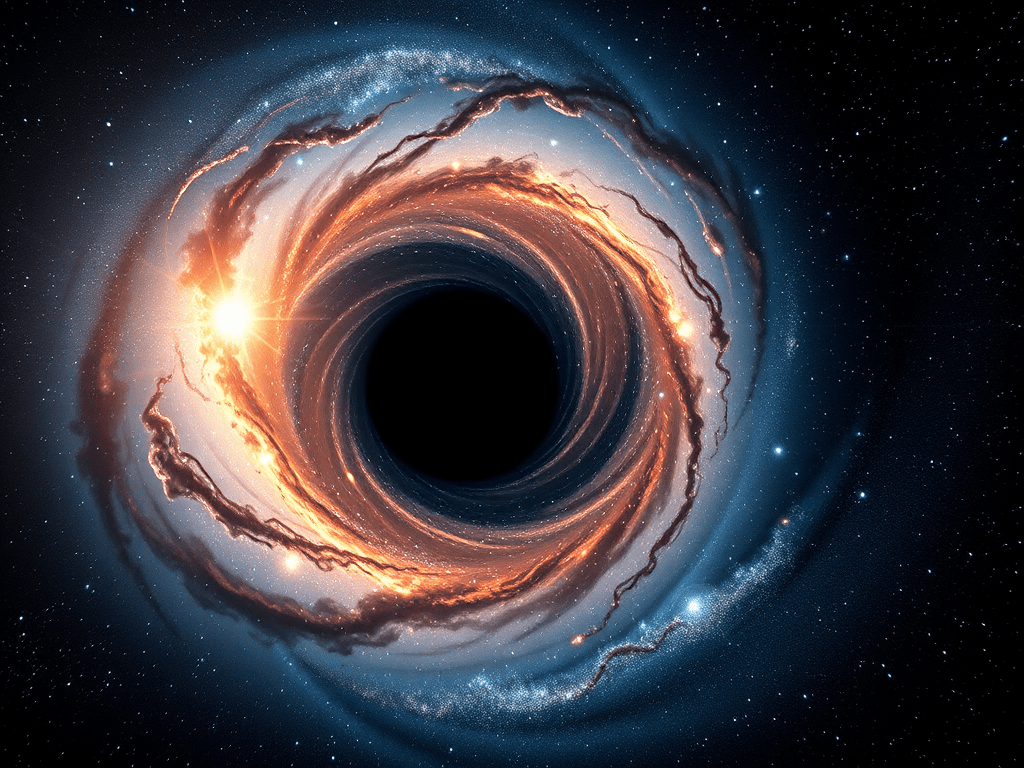
“The Milky Way is nothing else but a mass of innumerable stars planted together in clusters.” – Galileo Galilei
And at the heart of it all lies something even more incredible—Sagittarius A*.
In the vast reaches of our Milky Way galaxy, a powerful and mysterious force sits at its core. Known as Sagittarius A* (Sgr A*), this supermassive black hole has amazed scientists and space fans alike. With a mass about 4.297 million times that of our Sun, Sgr A* holds many of our galaxy’s secrets.
The story of Sgr A* began in 1974 when astronomers Bruce Balick and Robert L. Brown first spotted it through radio signals. In 1982, it got its official name, “Sagittarius A*,” to distinguish it from the larger Sagittarius A region. Located about 26,000 light-years from Earth in the constellation Sagittarius, this massive black hole is a standout feature in the night sky.
Around Sgr A* spins an accretion disk—a cosmic whirlpool of gas, dust, and debris caught in the black hole’s powerful pull. It forms when stray material, like gas from nearby stars, gets tugged in but doesn’t fall straight down. Instead, it swirls around Sgr A*, flattening into a disk as it bumps and grinds together. This swirling ring glows like a spotlight in space, heated to millions of degrees as the material rubs and spirals inward at incredible speeds. It’s not a steady shine, though—sometimes it flickers faintly, other times it flares up with hot spots, painting the galaxy’s core with bursts of light we can spot from Earth. From fuzzy red radio waves to sizzling X-ray glows, this disk is the black hole’s way of showing off, lighting up the darkness right up to the edge of the unseen event horizon, where everything vanishes into Sgr A*’s grasp.
Recent views from the James Webb Space Telescope (JWST) show Sgr A* is anything but quiet. It’s alive with flashes and dramatic bursts of light as gas and dust get yanked in by its gravity. These bursts surprise scientists, varying in brightness and length, like a dazzling fireworks show in space. The JWST has captured this action with its Near-Infrared Camera (NIRCam), watching Sgr A* for a total of 48 hours over a year. These long-term peeks have given us amazing insights into how the black hole behaves and interacts with its surroundings.
The importance of these discoveries goes beyond just looking. Sgr A* is a key testing ground for understanding gravity and the rules of space. By studying the stars orbiting it—like the star S2—scientists have figured out its mass and set limits on its size. The JWST’s data is helping experts fine-tune their ideas about black holes and how our galaxy has evolved.
As we keep exploring space, Sgr A* stands as a symbol of curiosity and wonder. Its lively activity and the insights from recent observations are growing our knowledge of black holes and revealing new details about the Milky Way’s core. With new tech and telescopes on the way, we’re in for even more exciting discoveries about these mysterious objects.
Fun Facts About Sagittarius A*
- Sagittarius A is about 4.297 million times the mass of the Sun, making it one of the heaviest black holes in our galaxy.*
- The Event Horizon Telescope’s image of Sgr A gave us the first direct look at its existence.*
- Despite its huge mass, Sgr A is pretty compact, with a diameter of about 27 million miles.*
Engaging Questions for Our Readers
- What do you find most fascinating about black holes, and why?
- How do you think the lively bursts of Sagittarius A change our view of the universe?*
- What other mysteries of the Milky Way would you love to explore?
- Do you think studying black holes like Sagittarius A could lead to big breakthroughs in space science? Why or why not?*
- How do you imagine tools like the James Webb Space Telescope will shape our future adventures in space?
We’d love to hear your thoughts and ideas! Share your perspectives and join the conversation about the incredible discoveries at the heart of our galaxy.
For More Information
If you’re eager to learn more about Sagittarius A* and the latest in space science, check out these great resources:
- NASA’s James Webb Space Telescope: See the latest findings and images from the JWST on NASA’s official JWST page.
- Event Horizon Telescope: Learn about the groundbreaking work behind the first black hole image, including Sgr A*, at the Event Horizon Telescope website.
- National Radio Astronomy Observatory (NRAO): Explore radio astronomy and black hole studies at the NRAO website.
- National Aeronautics and Space Administration (NASA): Keep up with space exploration news on NASA’s official website.
- Astronomy and Astrophysics Journals: Dig into research and articles on black holes and the galaxy in journals like The Astrophysical Journal and Astronomy & Astrophysics.
Sources
- “First Image of the Black Hole at the Center of Our Galaxy.” Event Horizon Telescope, 12 May 2022.
- “James Webb Space Telescope Observes Dynamic Activity in Sagittarius A*.” NASA, 2023.
- Balick, Bruce, and Robert L. Brown. “Discovery of Sagittarius A*.” The Astrophysical Journal, 1974.
- “Sagittarius A* and the Milky Way’s Center.” National Radio Astronomy Observatory (NRAO).



















































































 Ashes on Air
Thank you for taking the time to share your thoughts. Your voice is important to us, and we truly value your input. Whether you have a question, a suggestion, or simply want to share your perspective, we’re excited to hear from you. Let’s keep the conversation going and work together to make a positive impact on our community. Looking forward to your comments!