
A Cosmic Revelation
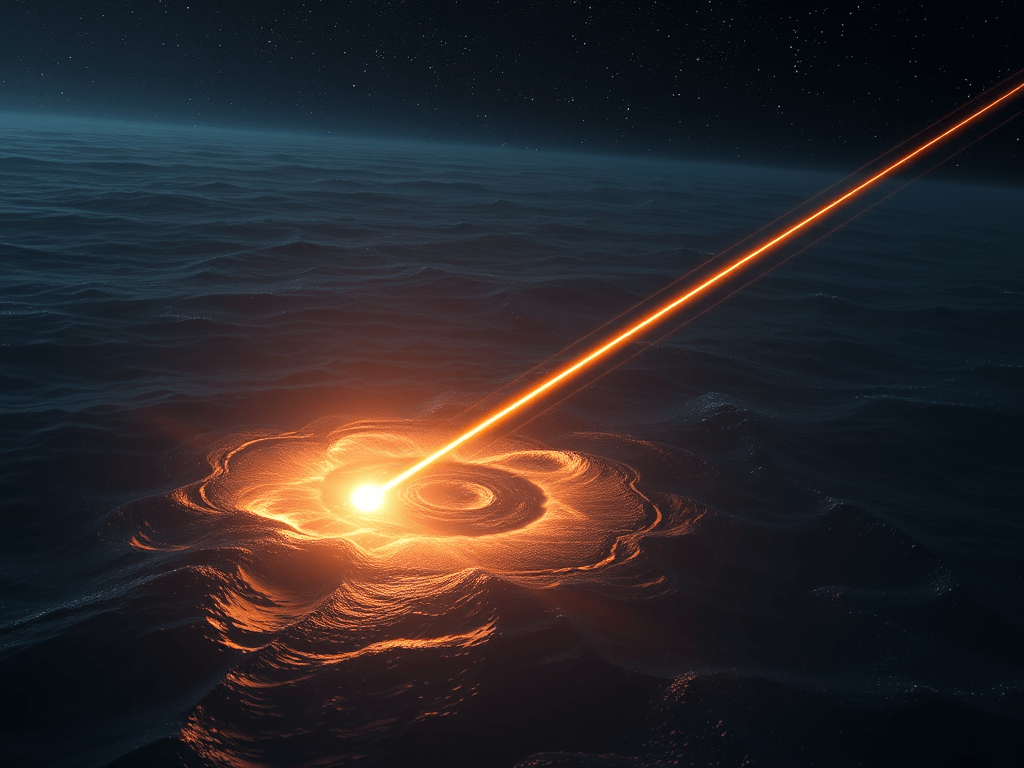
On February 13, 2023, an extraordinary event unfolded in the depths of the Mediterranean Sea, 3,000 meters below the surface off Sicily. A muon, a charged particle with an astounding 120 peta-electronvolts (PeV) of energy, streaked through the ocean, lighting up a third of the KM3NeT telescope’s sensors. Scientists traced this particle back to a neutrino, designated KM3-230213A, boasting an unprecedented 220 PeV of energy. Announced on February 12, 2025, in Nature, this discovery is not merely a scientific milestone but a tantalizing clue that might hold the key to understanding unidentified aerial phenomena (UAP).
A Needle in the Cosmic Haystack
Neutrinos are often described as the universe’s phantoms—near-massless and chargeless particles that can pass through planets unimpeded. Detecting one, especially at such high energy levels as KM3-230213A, is akin to finding a whisper in a hurricane. The KM3NeT team, consisting of over 360 researchers worldwide, achieved this feat using only 21 of their planned 230 sensor strings—barely a tenth of the full array. These sensors, submerged in the abyss near Portopalo di Capo Passero, detected the muon’s near-horizontal trajectory and immense energy, ruling out an atmospheric origin. This neutrino had traveled from deep space, possibly beyond our galaxy. The sources might include blazars, gamma-ray bursts, or something the Pentagon’s All-domain Anomaly Resolution Office (AARO) might not want to address.
The official narrative remains cautious. KM3NeT’s Aart Heijboer describes the discovery as evidence that “neutrinos of such high energies are produced in the Universe,” suggesting that this is a gateway to understanding cosmic accelerators like supernovae and black holes. However, the statistics raise questions. The IceCube Neutrino Observatory in Antarctica, which has been operational for 14 years, has detected neutrinos up to 10 PeV. The fact that KM3NeT discovered a 220 PeV neutrino after just 287 days challenges statistical expectations, causing skepticism among experts like IceCube’s Ignacio Taboada, who finds the numbers perplexing.
The UAP Whisper
Amid this scientific uncertainty, the UAP hypothesis emerges. Reports of UAPs, such as the Navy’s “Tic Tac” incidents and Rep. Tim Burchett’s account of a massive craft underwater, suggest propulsion mechanisms that defy conventional physics. These phenomena exhibit motion without visible jets or exhaust, as if harnessing unknown energy sources. Theoretical physicist Jack Sarfatti has long argued that advanced technology could utilize zero-point energy or warp spacetime, potentially emitting high-energy neutrinos as a byproduct. The deep underwater detection of KM3-230213A aligns with the characteristics of such technology.
Adding to the intrigue is the testimony of Jake Barber, an Air Force veteran, who recently claimed to have witnessed an egg-shaped “nonhuman” craft during a secret retrieval operation in 2002. Supported by three colleagues and a rumored video, Barber’s story has drawn AARO’s attention. David Grusch’s 2023 testimony about recovered nonhuman technology further fuels speculation. Could KM3-230213A be a particle escaping the Department of Defense’s scrutiny, representing advanced technology? The Mediterranean has a history of UAP sightings, such as the USS Trepang’s 1971 incident. This discovery might not be a cosmic coincidence but rather a localized phenomenon.
The Disclosure Dance
The government’s approach to UAP disclosures is predictable—present data while avoiding deeper implications. AARO’s November 2024 report documented 757 UAP sightings, with 21 exhibiting unusual behavior. However, the report adhered to conventional explanations: balloons, drones, no extraterrestrial involvement. Yet, testimony like Luis Elizondo’s November 2024 congressional statement about UAP-related injuries suggests a genuine issue. While neutrinos like KM3-230213A do not directly cause harm, a craft emitting them might. Both IceCube and KM3NeT have U.S. and European funding, indicating ongoing monitoring for cosmic or local phenomena.
Online discussions are fervent. Social media users link neutrinos to potential “UFO power plants” and even telepathy, exploring fringe theories. KM3-230213A’s immense energy—220 million billion electron volts—raises significant questions. This singular detection challenges the established neutrino flux mapped by IceCube, presenting a statistical anomaly. The KM3NeT team is expanding their sensor array, hoping to catch more such events. If another similar neutrino is detected, the natural origin theory will face further scrutiny.
What’s Next?
KM3-230213A is not definitive proof of extraterrestrial technology; it is a profound question mark. The neutrino could be a cosmogenic particle from a distant cosmic event or a blazar’s last burst. However, its discovery, amidst growing UAP inquiries and recent disclosures, seems significant. The universe reveals its secrets regardless of human agendas, and neutrinos do not adhere to secrecy. If this particle is indeed linked to UAP technology, it signals a challenge for the Department of Defense.
For now, KM3NeT continues its search for high-energy neutrinos, and the public remains vigilant, sifting through official documents, social media discussions, and elusive clues. Is this the beginning of disclosure, one particle at a time, or merely a cosmic anomaly? Time will tell, but the discovery of a 220 PeV neutrino suggests a story worth following closely.
For More Information
- KM3NeT Project: KM3NeT Official Website
- IceCube Neutrino Observatory: IceCube Official Website
- Pentagon’s All-domain Anomaly Resolution Office (AARO): AARO Overview
- Congressional Hearing on UAPs: Congress.gov
- David Grusch’s Testimony: Details on UAP Technology Recovery























































































 Ashes on Air
Thank you for taking the time to share your thoughts. Your voice is important to us, and we truly value your input. Whether you have a question, a suggestion, or simply want to share your perspective, we’re excited to hear from you. Let’s keep the conversation going and work together to make a positive impact on our community. Looking forward to your comments!