
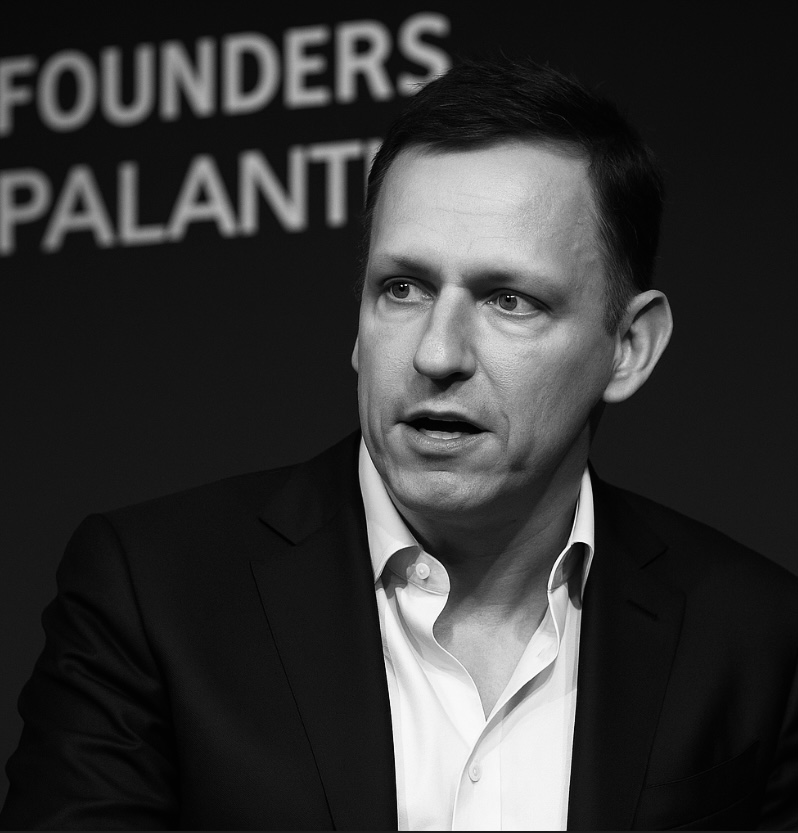
The Paradox of Peter Thiel
Peter Thiel is a billionaire venture capitalist, co-founder of PayPal and Palantir, early Facebook investor, and patron of ideas that unsettle the mainstream. His influence spans national security, artificial intelligence (AI), and defense technology to UAP research, radical life-extension science, and populist politics. Thiel’s worldview, shaped by philosopher René Girard, sees human nature as violent and tribal, with societies bound together by scapegoating outsiders. In his view, real progress depends on those willing to stand apart and challenge what the crowd condemns.
The Ideological Edge: Surveillance, Faith, and the Forbidden
His ventures embody this tension. Palantir’s surveillance platforms serve military and intelligence agencies; yet, Thiel argues that they protect Western freedoms rather than threaten them. In 2022, Founders Fund hosted Hereticon, an invitation-only gathering exploring taboo science, UAPs, and fringe philosophical ideas—designed to provoke conversation around societal blind spots.
The Machinery of Influence: Palantir and Strategic Technology
Palantir plays a leading role in the development and operationalization of advanced technologies. In the field of artificial intelligence and machine learning, its platforms—such as Foundry and Warp Speed—offer secure data foundations and end-to-end machine learning operations (MLOps), enabling organizations to build, integrate, and deploy AI models at scale. Palantir is also extending AI capabilities to the edge through partnerships with Qualcomm, bringing ontology and decision-making tools to environments with limited connectivity. In the military and defense sector, Palantir has developed TITAN (Tactical Intelligence Targeting Access Node), a mobile intelligence ground station for the U.S. Army. This system processes data from multiple sources to support targeting and situational awareness on the battlefield, leveraging artificial intelligence and machine learning. Its platforms, such as Foundry and Warp Speed, provide secure data foundations and end-to-end MLOps, enabling organizations to build, integrate, and deploy AI models at scale. The company is also extending AI capabilities to the edge, working with Qualcomm to deploy AI and Ontology features on edge computing platforms. This allows for real-time insights and decision-making in low-connectivity environments.
In the military and defense sector, Palantir developed TITAN (Tactical Intelligence Targeting Access Node), a mobile ground station for the U.S. Army that utilizes AI and machine learning (ML) to process data from multiple sources. TITAN supports targeting and situational awareness in complex battlespaces. The company’s commitment to defense includes supporting AI-driven decision-making and enhancing battlefield connectivity.
Palantir partners with technology leaders such as Qualcomm, Accenture Federal Services, and Divergent to enhance the Industrial Internet of Things (IoT), secure government operations, and advance manufacturing. With Divergent, Palantir integrates on-demand production and resilient supply chain capabilities into its software platforms. Across these domains, Palantir emphasizes secure data foundations and interoperability with model providers and open-source tools, allowing organizations to operate with greater flexibility and technical autonomy.
Power and Politics: Backing Disruption from the Shadows
Politically, Thiel’s millions support populist Republicans like J.D. Vance and Blake Masters, who are critics of globalism and defenders of national identity. At the same time, he funds elite think tanks, controversial defense startups like Anduril, and alternative media. To Thiel, this is balance, not contradiction: power that challenges stagnation, tempered by faith that guards against tyranny.
Hereticon and the Philosophy of Heresy
Thiel’s career is a study in paradox: defending the West with surveillance tools while provoking it with forbidden ideas; embracing faith while funding heresy. Critics call it hypocrisy; he calls it strategy. Thiel often positions himself among ‘heretical thinkers’—a term he embraces to describe those who challenge ideological orthodoxy. This framing was on full display at Hereticon, a Founders Fund event designed to spotlight ideas considered too controversial for mainstream discourse. Speakers included evolutionary psychologist Diana Fleischman, known for exploring controversial topics around reproductive selection. Her inclusion reflected Hereticon’s embrace of taboo or fringe scientific discourse—not necessarily endorsement, but provocation. In a world where conformity stifles innovation and scapegoats sustain the status quo, Thiel argues that only by embracing intellectual heresy can society make meaningful progress.
Thiel, the Unknown, and the UAP Question
Thiel’s fascination with what lies beyond conventional science extends into the territory of Unidentified Aerial Phenomena (UAP). While he’s made few public statements on the topic, his financial and institutional ties suggest a quiet but significant presence in the UAP research ecosystem.
In 2021, Thiel reportedly backed Harvard astrophysicist Avi Loeb’s Galileo Project, a scientific initiative dedicated to studying anomalous aerial phenomena with academic rigor. The project aims to develop new instrumentation, algorithms, and observational platforms to investigate UAP without the stigma that has historically surrounded the field. Loeb, known for his theory that interstellar object ‘Oumuamua could be artificial, embodies the kind of taboo-challenging scientific curiosity that resonates with Thiel’s worldview.
Beyond Galileo, Thiel’s Palantir software has been speculated to support data integration efforts within government agencies investigating UAP. While no official confirmation links Palantir to the Pentagon’s All-domain Anomaly Resolution Office (AARO), the company’s long-standing contracts with intelligence agencies and its capacity for integrating high-volume sensor data across platforms make it a likely candidate for backend support—particularly for mission tracking, anomaly classification, or pattern recognition.
Thiel’s interest in UAP may reflect deeper philosophical instincts: a challenge to materialist orthodoxy, a wager on the unknown, or a belief that the future may hinge on technologies or intelligences we don’t yet understand. Whether as financier, facilitator, or quiet observer, his position in the expanding UAP landscape mirrors his broader approach—operating at the edge of power, possibility, and perception.

Inside Palantir’s Gotham: What It Is and Why It Matters
Capabilities
Palantir’s most potent and controversial software product is Gotham, a platform designed for intelligence agencies, law enforcement, and the military. Gotham integrates massive volumes of structured and unstructured data—surveillance feeds, satellite imagery, phone records, financial transactions, social media—and links it into a single, unified operational picture. Analysts can reconstruct past events, predict future ones, and coordinate operations across agencies using AI-powered link analysis, alerts, and predictive modeling.
AI and Ontology Use
At its core, Gotham constructs an “ontology” of the real world, defining people, objects, events, and relationships in machine-readable terms. This enables the system to connect previously isolated data sources. For example, it can track an individual’s movements, communications, and financial patterns to identify networks or anomalies in real-time. These features are underpinned by machine learning and AI to accelerate insight generation and automate threat recognition.
Clients and Deployments
Gotham’s tools are utilized by the Central Intelligence Agency (CIA), the Federal Bureau of Investigation (FBI), the National Security Agency (NSA), U.S. Immigration and Customs Enforcement (ICE), and numerous military commands across the North Atlantic Treaty Organization (NATO) and the Five Eyes alliance. It’s embedded in battlefield operations and has been deployed in conflict zones, such as Ukraine. Local and state-level law enforcement agencies also use Gotham, often in secretive or semi-public pilot programs.
Controversies
Critics argue Gotham enables mass surveillance and predictive policing on an unprecedented scale. The American Civil Liberties Union (ACLU) has raised concerns that Palantir’s partnerships with law enforcement, particularly through ICE, allow for dragnet-style data collection and undocumented surveillance of immigrants. In 2020, a coalition of civil rights organizations filed Freedom of Information Act (FOIA) requests and legal challenges to expose how Palantir’s software was used in raids and deportations. The Electronic Frontier Foundation (Electronic Frontier Foundation (EFF)) has warned that tools like Gotham can automate racial profiling or make opaque, algorithm-driven decisions with little oversight. Former Palantir employees have also spoken anonymously about the ethical conflicts within the company, including pressure to overlook how client agencies utilize the tools operationally. And predictive policing on a scale never before possible. Its use by ICE in deportation operations drew national protests and scrutiny from privacy watchdogs. Civil liberties groups have raised alarms about due process, algorithmic bias, and lack of transparency in how Gotham is deployed and audited.
Comparison to Foundry
Gotham is distinct from Palantir Foundry, which serves corporate and healthcare clients. Where Foundry optimizes business and public health outcomes, Gotham is a military-grade fusion engine for warfighters and intelligence officers. Together, they form a core part of Thiel’s belief in technological power—but that power is inseparable from his Girardian worldview. In Thiel’s mind, surveillance tools like Gotham do not just protect civilization from external threats; they also expose the mechanisms of internal scapegoating that Girard believed drove collective violence. This introduces a moral paradox: by enabling unprecedented visibility and control, Thiel’s technologies could both prevent mass violence and will allow it, depending on who wields them. The tension between salvation and domination lies at the core of Thiel’s broader philosophical bet on technology. To preserve and protect Western civilization.
Palantir’s most potent and controversial software product is Gotham, a platform designed for intelligence agencies, law enforcement, and the military. Gotham integrates massive volumes of structured and unstructured data—surveillance feeds, satellite imagery, phone records, financial transactions, social media—and links it into a single, unified operational picture.
At its core, Gotham constructs an “ontology” of the real world, defining people, objects, events, and relationships in machine-readable terms. This enables the system to connect previously isolated data sources. For example, it can track an individual’s movements, communications, and financial patterns to identify networks or anomalies in real-time.
The CIA, FBI, NSA, ICE, and numerous military commands across NATO and the Five Eyes alliance use Gotham’s tools. It’s also embedded in local law enforcement and battlefield operations. Analysts can reconstruct past events, predict future ones, and coordinate operations across agencies—using AI-powered link analysis, alerts, and predictive modeling.
Critics argue Gotham enables mass surveillance and predictive policing on a scale never before possible. It was notably used in ICE deportation operations, drawing protests and public outcry. Yet to its defenders, Gotham is a necessary response to a chaotic, data-saturated world—one where failing to integrate intelligence is often more dangerous than the tools used to do so.
Gotham is distinct from Palantir Foundry, which serves corporate and healthcare clients. Where Foundry optimizes business and public health outcomes, Gotham is a military-grade fusion engine for warfighters and intelligence officers. Together, they form a core part of Thiel’s belief in the power of technology to preserve and protect Western civilization.
Editor’s Note: This article is an investigative profile grounded in public records, verified sources, and published statements. It is not intended as praise or condemnation, but as a map of influence, ideology, and technology where they intersect.
Sources & citations:
- Zero to One by Peter Thiel & Blake Masters (2014)
- Hoover Institution interview, “Peter Thiel on René Girard” (2018)
- “The Education of a Libertarian” (Cato Unbound, 2009)
- “Technology and Liberty” (Wall Street Journal, 2009)
- National Conservatism Conference speech (2019)
- Media coverage of Hereticon: The Atlantic (2022), Bloomberg (2022)
- Qualcomm and Palantir press release, March 2025
- ExecutiveGov, “Palantir’s TITAN: the Army’s Bet on AI and Connectivity” (May 2025)
- Palantir.com, “Artificial Intelligence & Machine Learning Offerings”
































 Ashes on Air
Thank you for taking the time to share your thoughts. Your voice is important to us, and we truly value your input. Whether you have a question, a suggestion, or simply want to share your perspective, we’re excited to hear from you. Let’s keep the conversation going and work together to make a positive impact on our community. Looking forward to your comments!