

June 10, 2025
In the early 2000s, as the U.S. military rapidly expanded its operations in Afghanistan and Iraq, another, less visible system also took root in the field: biometric surveillance. Central to that effort was a device known as HIIDE—short for Handheld Interagency Identity Detection Equipment. Initially developed by L-1 Identity Solutions, HIIDE marked a new era of military-grade identity tracking, one that quietly transformed counterinsurgency strategies through the use of iris scans and fingerprint matching.
But nearly two decades later, HIIDE has all but disappeared. What happened to this once-essential tool? And what legacy does it leave behind in today’s age of biometric surveillance?
What Was HIIDE?
HIIDE was a rugged, portable biometric device that allowed troops in the field to collect and match iris, fingerprint, and facial data. Soldiers deployed it at checkpoints, during raids, and across rural villages, capturing the identities of thousands of civilians, detainees, and combatants alike.
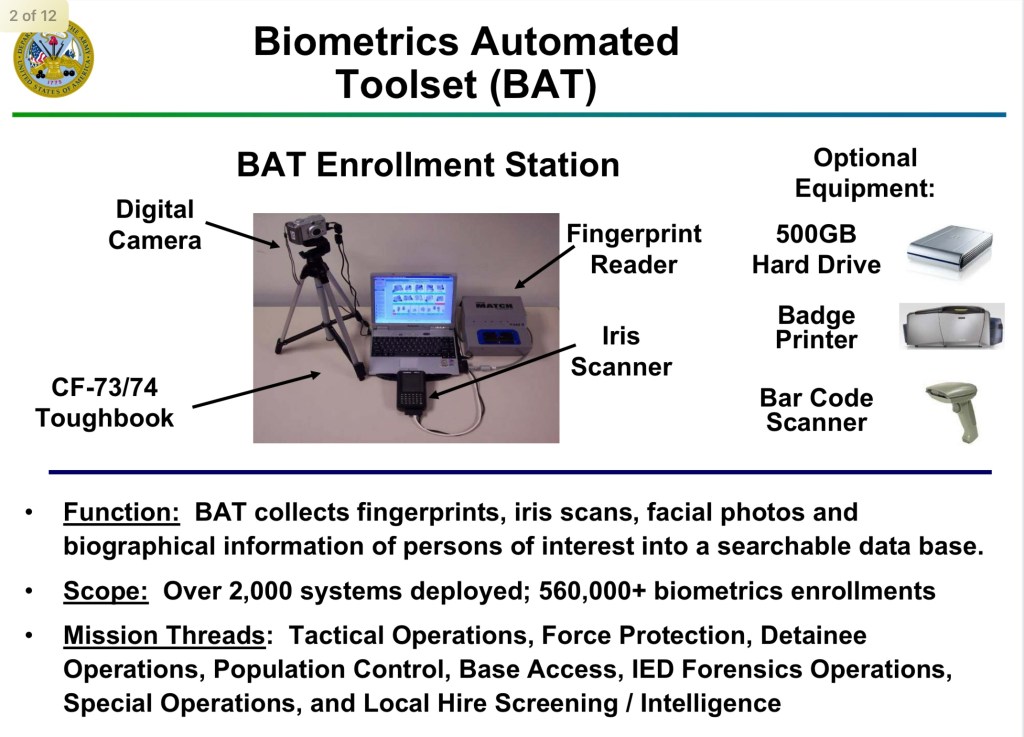
The device could store up to half a million profiles by 2010 and be integrated with larger military databases, such as the Biometric Automated Toolset (BAT). According to a 2010 piece in New Atlas, the HIIDE was “designed to scan and identify using iris, fingerprint, and facial features on the battlefield.” Each unit could match new entries against tens of thousands of stored identities—a mobile biometric black box.
A 2009 U.S. Army article outlined HIIDE’s operational value in Baghdad, where troops used it to vet members of the Iraqi police. Another 2011 OpsLens report claimed HIIDE was part of a broader Pentagon strategy to “biometrically catalog 80% of Afghanistan’s population.”

Who Built It?
HIIDE was developed by L-1 Identity Solutions, a company formed in 2006 through the merger of Viisage Technology and Identix. The company focused on biometric software and government contracts, providing face recognition and digital ID technologies. In 2011, L-1 was acquired by French defense conglomerate Safran, and its biometric division was folded into MorphoTrust USA. By 2017, Morpho had rebranded as Idemia, which continues to operate in the biometric sphere today.
However, there is no evidence that Idemia continues to manufacture HIIDE or support its legacy. Trademark records show the HIIDE name—originally filed by Securimetrics in 2006—was annulled in April 2021. While Idemia remains active in facial recognition and digital ID for governments, HIIDE seems to have quietly aged out of use.
Deployment in the Field
The Pentagon issued thousands of HIIDE devices between 2006 and 2013. Procurement reports from that time show multiple large-scale contracts: an initial $4.7 million deal with Securimetrics in 2005, a $10 million follow-up in 2006, and a $71 million umbrella contract secured by L-1 Identity Solutions in 2007.
By 2009, over 7,500 HIIDE units were deployed. A Defense Daily report from 2014 cites then-project chief Sandy Vann-Olejasz, who confirmed that HIIDE 4 systems were reaching the “end of life” and that support for the devices was ending.
Despite this, the U.S. Department of Defense continued to issue biometric guidance for similar tools, shifting its focus to more modern platforms, such as the SEEK II (Secure Electronic Enrollment Kit), developed by Crossmatch (now HID Global). Unlike HIIDE, SEEK II is still in use and connects directly to the Department of Defense’s Automated Biometric Identification System (ABIS).
Obsolescence and Seizures
Though HIIDE devices were phased out around 2014, they made headlines again in 2021. During the U.S. military withdrawal from Afghanistan, reports surfaced that Taliban fighters had seized U.S. biometric devices—including HIIDE and SEEK II units—abandoned in the field. A story from The Intercept raised concerns about whether sensitive biometric data had fallen into the wrong hands.
Yet most experts dismissed the alarm—a follow-up investigation by French outlet Next. Ink pointed out that even if the Taliban had obtained the devices, they likely lacked the technical infrastructure—and the encryption keys—to access U.S. biometric databases. By that point, HIIDE was considered long obsolete.
Additional security measures were in place. Devices locked after multiple failed logins, and many included self-erasing “destruction keys.” Encryption standards in later versions, particularly HIIDE V5, were considered robust by contemporary military standards.
The Bigger Picture
HIIDE’s story reflects the broader evolution of biometric warfare. Once considered cutting-edge, the device is now a relic of a transitional period—between analog checkpoints and today’s integrated, cloud-based identity systems.
Its development also underscores the blurred lines between defense contractors, data privacy, and the human cost of counterinsurgency. A 2011 Government Accountability Office (GAO) report criticized the Pentagon for failing to ensure biometric data could be effectively shared with other federal agencies, further complicating its utility across the intelligence community.
HIIDE served its purpose during a specific phase of U.S. military strategy. But as newer systems emerge—leveraging AI, mobile networking, and real-time analytics—the device’s demise speaks volumes about the speed at which biometric surveillance tools are deployed, discarded, and replaced.
Is This the End?
HIIDE may be out of circulation, but its legacy lives on in every facial recognition system and mobile ID scanner used by governments today. The question now is not whether biometrics will define future conflicts but whether the lessons of early devices like HIIDE will shape how we balance security and privacy in the long run.
For investigative reporting like this, subscribe to AshesOnAir.org and stay informed on the silent machinery behind modern surveillance.
Key Sources:
- GAO Report on Biometrics
- New Atlas: HIIDE Biometric Scanner
- Next. Ink: Debunking Biometric Panic
- Defense Daily: Army Phases Out HIIDE
- https://www.nist.gov/system/files/documents/2021/03/23/ansi-nist_archived_vermury-bat-hiide.pdf
- Story from Intercept: https://theintercept.com/2021/08/17/afghanistan-taliban-military-biometrics/
































 Ashes on Air
Thank you for taking the time to share your thoughts. Your voice is important to us, and we truly value your input. Whether you have a question, a suggestion, or simply want to share your perspective, we’re excited to hear from you. Let’s keep the conversation going and work together to make a positive impact on our community. Looking forward to your comments!