
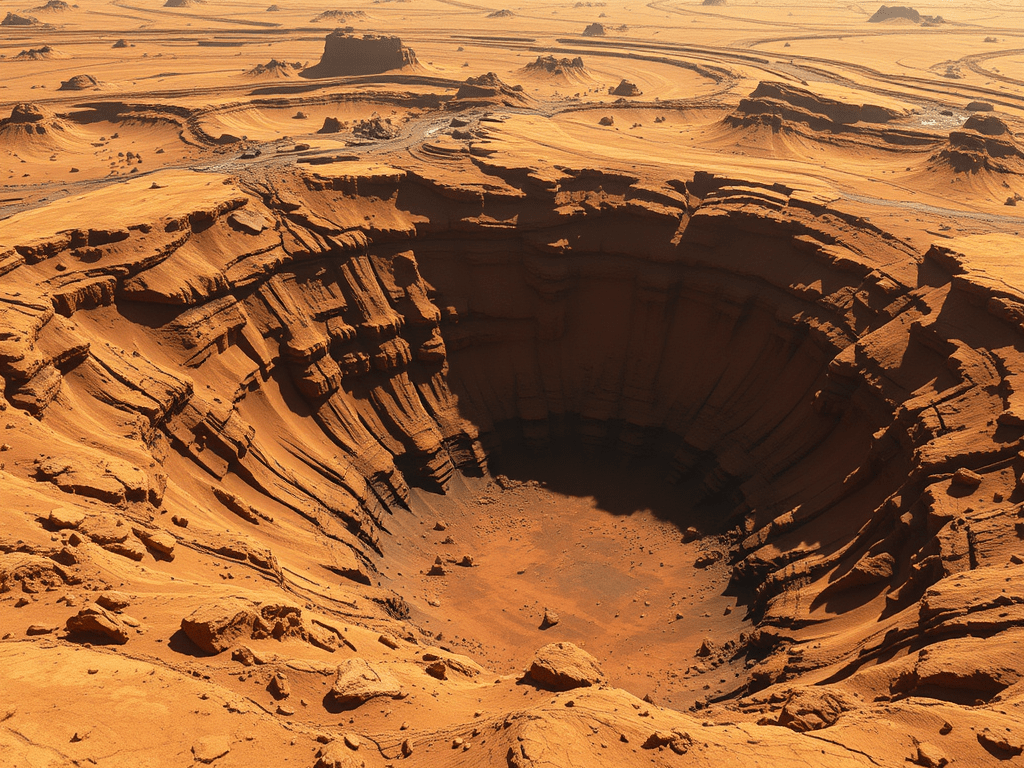
Thursday, March 6, 2025, PST – 6-minute read – A groundbreaking 5.7 trillion pixel mosaic of Mars, crafted by Caltech’s Murray Lab, offers a new lens on the Red Planet’s surface.
Imagine standing on the edge of a Martian crater, the rusty expanse stretching out before you, every ripple and ridge captured in stunning clarity. Now, thanks to the Murray Lab at Caltech, that vision is closer to reality than ever before. Their Global CTX Mosaic of Mars, accessible at a dedicated online viewer, isn’t just a map—it’s a 5.7 trillion pixel masterpiece that lays bare 99.5% of the planet’s surface, from 88°S to 88°N, at a resolution of 5 meters per pixel. That’s about the size of a parking space, small enough to spot a rover’s tracks or a boulder’s shadow, yet vast enough to encompass nearly the entire globe of Mars.
This isn’t a project born overnight. The mosaic stitches together 86,571 images snapped by the Context Camera, or CTX, aboard NASA’s Mars Reconnaissance Orbiter between 2006 and 2020. Scientists at the Bruce Murray Laboratory for Planetary Visualization, led by figures like Jay Dickson, took on the Herculean task of aligning these overlapping snapshots—a process they call semi-controlled registration—before blending them into a seamless whole. The result, released as Version 01, is more than a pretty picture; it’s a tool for science and exploration, with every pixel traceable back to its original source image, ensuring no detail gets lost in translation.
What makes this mosaic stand out isn’t just its scale but its accessibility. Through an interactive 3D viewer, anyone with a browser can zoom into places like Jezero Crater, where the Perseverance rover roams, or the towering slopes of Olympus Mons. Scroll up to dive into the details, drag to pan across vast chasms like Valles Marineris, or rotate to shift your perspective—it’s a hands-on journey across Mars. There’s a caveat, though: on some screens, topographic quirks might look like artificial cliffs at high zoom, a reminder of the data’s raw, unpolished honesty.
Behind the scenes, the Murray Lab’s approach is as much about transparency as it is about technology. They’ve built a Python-based pipeline that preserves the integrity of each image, mapping seams and tie points so users can see exactly where the data comes from. Want the raw files? They’re available for download—massive GeoTIFFs paired with shapefiles that outline every stitch in the mosaic. It’s a nod to researchers and enthusiasts alike, offering a direct line to the same data that fueled this creation, as detailed on the lab’s site.
The Context Camera itself deserves a shoutout. Built by Malin Space Science Systems and mounted on the Mars Reconnaissance Orbiter—crafted by the Jet Propulsion Laboratory—it’s been a workhorse since the orbiter’s launch in 2005. Its 5-meter resolution strikes a balance between wide coverage and fine detail, making it perfect for a project of this ambition. The mosaic’s roots trace back to years of observation, with the Murray Lab’s efforts culminating in a 2023 release celebrated at the Lunar and Planetary Science Conference.
For scientists, this is a goldmine. Geologists can trace fault lines, hydrologists can study ancient riverbeds, and mission planners can scout landing sites—all with a clarity that rivals standing on Martian soil. For the rest of us, it’s a chance to explore a world 140 million miles away, no spacesuit required. The lab’s acknowledgment of Malin Space Science Systems and JPL underscores the teamwork behind this feat, a collaboration spanning decades and disciplines.
As you navigate this digital Mars, consider what it means to see a planet in such detail. It’s not just a technical triumph—it’s an invitation to wonder, to question, and to dig deeper. Check out the full mosaic yourself at the Murray Lab’s viewer, and share your favorite Martian discovery in the comments below.
Sources
- The Murray Lab – Global CTX Mosaic Viewer – Interactive 3D viewer of the 5.7 trillion pixel mosaic.
- The Murray Lab – Mosaic Overview – Details the mosaic’s 5 m/px resolution and 99.5% coverage.
- The Murray Lab – Data Access – Offers downloads of GeoTIFFs and seam maps.
- Astropedia – CTX Mosaic V01 – Confirms 86,571 images from 2006-2020 and semi-controlled registration.
- Malin Space Science Systems – CTX Info – Background on the Context Camera’s design and capabilities.






















 Ashes on Air
Thank you for taking the time to share your thoughts. Your voice is important to us, and we truly value your input. Whether you have a question, a suggestion, or simply want to share your perspective, we’re excited to hear from you. Let’s keep the conversation going and work together to make a positive impact on our community. Looking forward to your comments!