
October 2025
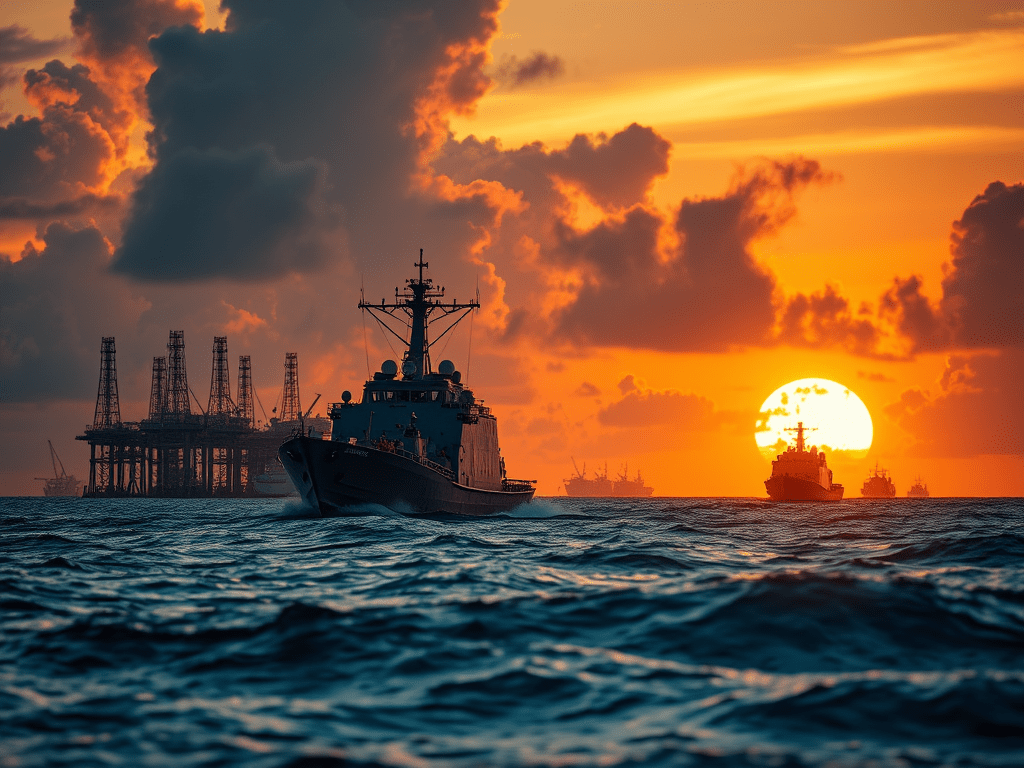
The United States says it’s fighting drugs in the Caribbean. The maps tell another story. Each “routine” patrol, every reconnaissance flight, every vessel deployed under the banner of counter-narcotics quietly traces the perimeter of the hemisphere’s newest oil frontier.
Beneath the surface language of interdiction lies a different mission: securing maritime routes, stabilizing Western energy stakes, and containing a petro-state whose collapse threatens to redraw South America’s geopolitical lines.
For Venezuela, crude remains oxygen. For Guyana, it’s a ladder out of poverty. For Washington, it’s a line of containment stretching from the Gulf of Paria to the Atlantic shelf. The war being waged off those coasts isn’t just against traffickers—it’s over control of the flow.
The Border That Became an Oil Line
Venezuela still holds the world’s largest proven oil reserves, but its production has fallen to less than a third of what it once was. Official documents reviewed by Reuters show that in 2024 PDVSA managed about $17.5 billion in export sales—barely enough to keep the lights on. Years of sanctions, corruption, and technical decay have stripped the company to scaffolding.
Across the border, Guyana’s oil story has just begun. ExxonMobil’s Stabroek Block discoveries turned the small nation into an overnight producer of hundreds of thousands of barrels a day. The reserves sit off the coast of Guayana Esequiba, a region claimed by Venezuela since the 1800s. When Caracas saw offshore rigs rising in what it considers stolen waters, it revived the century-old dispute with newfound urgency.
Maduro’s 2023 referendum to “reclaim” Esequibo was more than populist posturing—it was an oil-backed declaration that Venezuela intended to reassert itself as a regional power. The move drew condemnation abroad and anxiety at home, followed quickly by Venezuelan coast-guard patrols approaching Guyanese-administered oil blocks. Guyana protested, the International Court of Justice warned restraint, and Washington quietly increased its footprint in nearby waters.
The Patrols No One Talks About
U.S. defense officials still describe their operations as counter-narcotics missions. But the pattern of deployments tells a different story. Surveillance aircraft and naval assets concentrate around Guyana’s exclusive economic zone—the same corridor where Venezuelan patrols have appeared. The timing of those flights tracks not with cartel interdictions but with oil-production surges, sanction renewals, and high-level energy summits.
What’s presented as drug enforcement functions equally as a shield for investment. The same radar systems that follow smugglers monitor sanction-dodging tankers. The same logistics bases that support interdiction teams now service intelligence aircraft watching the Atlantic shelf. America’s anti-narcotics apparatus has become a ready-made framework for defending an energy frontier.
Deterrence by Another Name
Inside defense circles, officials call it “persistent presence.” In practice, it’s a deterrent—a reminder to Caracas, Moscow, and Beijing that the Atlantic approaches to South America remain within the U.S. sphere of influence. The Caribbean has become the staging ground for a modern form of quiet containment: fewer speeches, more sensors.
Chinese and Russian firms now operate inside Venezuela’s oil fields under long-term pacts. Iranian tankers deliver diluents and take on crude in barter arrangements. Each partnership erodes Western leverage and heightens the sense that the Caribbean isn’t a peripheral theatre anymore but a contested frontier between rival blocs.
In that context, “drug interdiction” is a convenient brand—an apolitical way to justify surveillance, deterrence, and naval readiness without admitting the true objective. It’s easier to explain chasing smugglers than protecting Exxon.
The Illusion of the War
Every conflict needs a palatable story. The U.S. drug war provided one for decades: a mission of moral clarity that rationalized fleets, bases, and budgets. But in the post-sanctions landscape, that same machinery now underwrites an energy war conducted in silence. It polices trade flows, safeguards corporate infrastructure, and monitors the thin line where Venezuelan waters meet Guyana’s newfound wealth.
For the people of the region, the result is the same sky filled with aircraft, the same waters patrolled by foreign ships—but the stakes have changed. What once was about cocaine has become about crude.
The Lines That Matter
The frontiers drawn in these waters are no longer just political—they’re economic and existential. Every barrel that leaves Guyana’s coast diminishes Venezuela’s leverage. Every new offshore platform invites another military exercise nearby. The language of interdiction conceals a proxy contest over energy, influence, and survival.
If the twentieth century’s Caribbean wars were fought with ideology, the twenty-first’s are fought with infrastructure. The question is no longer who controls the cocaine routes, but who controls the currents.
Additional articles to look at….
- Reuters, “Venezuela’s PDVSA oil sales abroad hit $17.5 billion in 2024 as exports jump,” Jul 11 2025.
- Reuters, “Guyana says Venezuelan vessel entered oil block in Guyanese waters,” Mar 1 2025.
- Reuters, “U.S. to conduct flight operations in Guyana as concerns mount over border spat,” Dec 7 2023.
- Reuters, “Venezuela’s oil exports on the rise as more cargoes head to China,” Jul 2 2025.
























 Ashes on Air
Thank you for taking the time to share your thoughts. Your voice is important to us, and we truly value your input. Whether you have a question, a suggestion, or simply want to share your perspective, we’re excited to hear from you. Let’s keep the conversation going and work together to make a positive impact on our community. Looking forward to your comments!