

A new bounty, a new label, and a dangerous new frontier in U.S.–Venezuela relations
The Price on Maduro’s Head Just Doubled
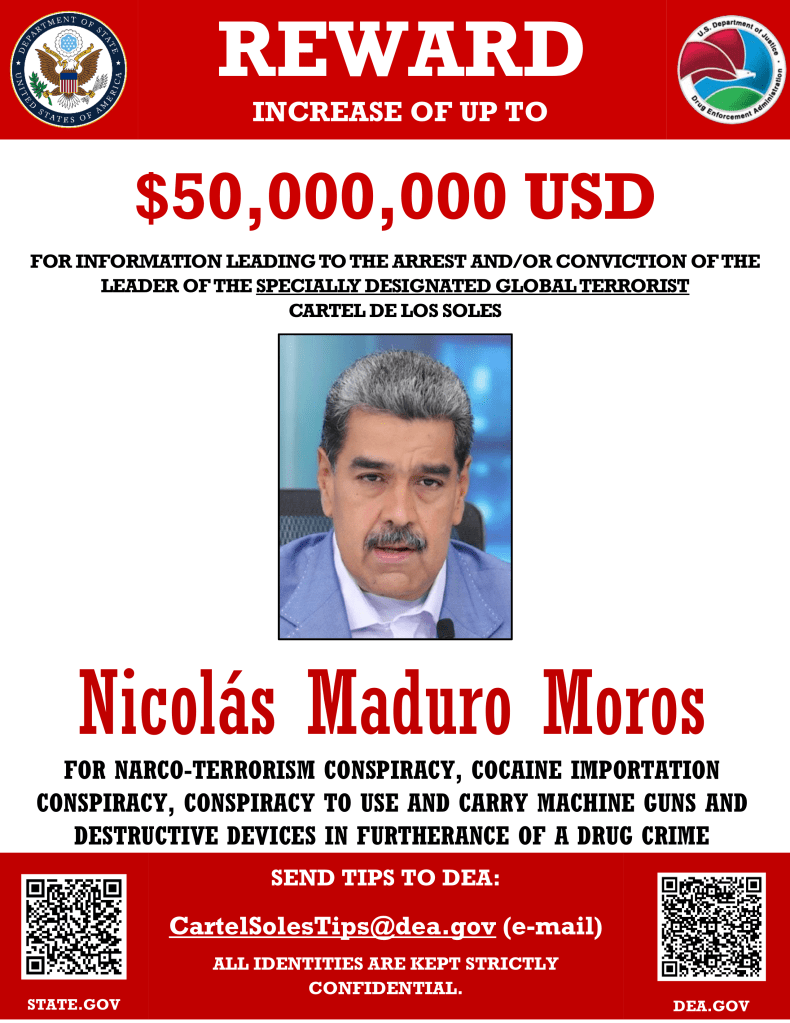
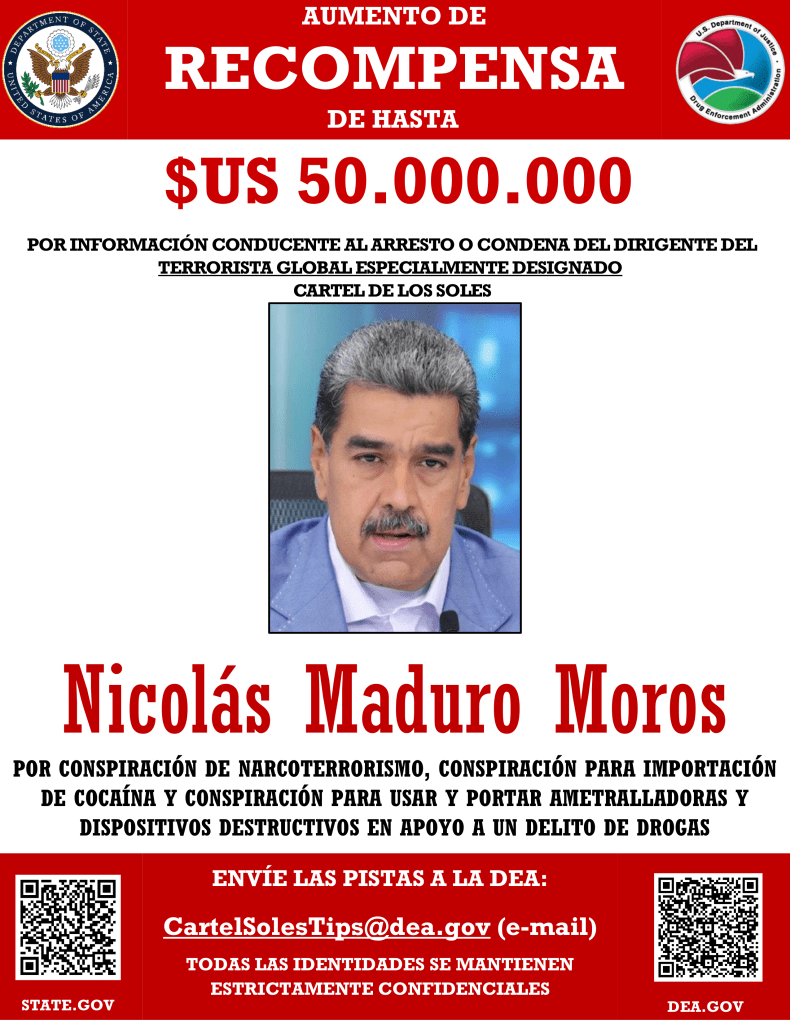
On August 7, 2025, the U.S. Department of State announced it was doubling the reward for information leading to the arrest or conviction of Venezuelan leader Nicolás Maduro to a staggering $50 million. The announcement, delivered by Secretary of State Marco Rubio, framed the move as part of the Narcotics Rewards Program and a pillar of President Trump’s “America First” law-and-order agenda.
This is more than a number. It marks a decisive escalation in the U.S. strategy against Maduro—elevating him from a narco-criminal already under indictment to the level of global fugitive with a bounty rivaling the most wanted terrorists on Earth.
The Cartel de los Soles: From Shadow Network to “Terrorist” Designation
At the center of this shift is the Cartel de los Soles, a military-linked criminal enterprise the U.S. has long accused Maduro of leading.
In March 2020, the Southern District of New York indicted Maduro and 14 others on charges of narco-terrorism, describing how the Cartel worked with Colombia’s FARC guerrillas to pump tons of cocaine into U.S. streets.
On July 25, 2025, the U.S. Treasury formally designated the Cartel de los Soles as a Specially Designated Global Terrorist entity, describing it as a syndicate “headed by Nicolás Maduro Moros” that provided protection and logistical support to the Tren de Aragua and Sinaloa Cartel.
This isn’t just semantics. By branding the cartel as a terrorist organization, Washington unlocks a new toolkit: harsher sanctions, financial isolation, international cooperation, and even legal justification for more aggressive covert or military actions.
Terrorist Cartels: A New U.S. Doctrine
The Cartel de los Soles isn’t the only group to be recast under the terrorism umbrella. In early 2025, the Sinaloa Cartel was labeled both a Foreign Terrorist Organization and an SDGT. Venezuela’s own Tren de Aragua—a fast-expanding syndicate feared from Bogotá to Santiago—was also designated an FTO.
This policy shift means Maduro’s alleged partners are no longer just organized criminals—they are classified alongside al-Qaeda and ISIS. The message: the U.S. sees Latin America’s cartels as a direct national security threat, not just a law-enforcement problem.
Democracy Choked, Legitimacy Denied
The U.S. also used the reward announcement to underline Maduro’s lack of legitimacy. Washington flatly rejects his claim to have won the July 28, 2024 election, calling it a fraud. This continues a bipartisan policy of non-recognition that stretches back to 2018, when Maduro’s second-term “victory” triggered international condemnation.
By pairing the fraud narrative with the terrorism designation, Washington is painting a two-dimensional picture of Maduro: not only an illegitimate leader clinging to power, but a terrorist-cartel boss operating under the cover of a failed state.
Maduro’s Counterpunch: Militia and Defiance
Maduro, unsurprisingly, has not backed down. In the wake of the U.S. bounty and naval deployments, he mobilized 4.5 million civilian militia members, vowing they would “defend every inch” of Venezuela. State television has broadcast footage of armed parades, while Maduro insists the U.S. moves are nothing more than regime-change dressed up as counter-narcotics policy.
His rhetoric portrays Venezuela as a victim of “imperialist aggression”—a narrative with deep roots in Latin America, where U.S. military posturing often triggers regional backlash.
Regional Fallout: Support and Skepticism
The Caribbean and Latin America are split. Trinidad and Tobago openly backed U.S. naval deployments, even offering basing access if Venezuela threatened Guyana in their ongoing border dispute. Other governments, from the Caribbean Community (CARICOM) to Mexico, have condemned what they call “imperialist saber-rattling,” warning that military brinksmanship risks destabilizing the entire hemisphere.
The split highlights the fragile geopolitical balance: Washington’s terrorism framing may rally some allies, but it risks alienating neighbors wary of another interventionist play.
Timeline of Escalation: 2020–2025
| Date | Action | U.S. Framing |
|---|---|---|
| Mar 26, 2020 | DOJ indicts Maduro & allies for narco-terrorism | Narco-terror, criminal conspiracy |
| Jan 10, 2025 | Reward raised to $25M after disputed inauguration | Criminal fugitive, illegitimate leader |
| Jul 25, 2025 | Cartel de los Soles designated as SDGT | Terrorist entity, global threat |
| Aug 7, 2025 | Reward doubled to $50M (Rubio announcement) | Fugitive + terrorist cartel boss |
Why This Escalation Matters
By doubling the bounty and invoking terrorism law, the U.S. has taken a qualitative leap.
It is no longer about justice or sanctions—it’s about delegitimizing Maduro as a terrorist kingpin.
It shifts the legal basis for action, opening the door to covert capture attempts, broader intelligence operations, and even military interdictions under counter-terrorism doctrine.
It raises the stakes for regional allies, who must now choose sides in what could be a new proxy conflict in the Americas.
Conclusion: From Cocaine to Counter-Terrorism
Nicolás Maduro has long been painted by Washington as a dictator clinging to power through fraud, corruption, and repression. What’s changed in 2025 is the scale and scope of U.S. pressure: Maduro is no longer just an indicted narco-criminal with a price on his head—he is a terror-designated fugitive, one of the most wanted men on the planet.
The narrative is clear: the U.S. is preparing the legal, political, and military battlefield for a future where Maduro is not treated as a head of state, but as a cartel-terrorist leader to be hunted down.
Further Reading
- U.S. Department of Justice, United States v. Nicolás Maduro Moros et al. (2020 Indictments, SDNY)
- U.S. Department of State, Reward Offer Increase for Nicolás Maduro under NRP (Aug 7, 2025 Press Statement)
- U.S. Department of the Treasury, Designation of Cartel de los Soles as SDGT (Jul 25, 2025 Press Release)































 Ashes on Air
Thank you for taking the time to share your thoughts. Your voice is important to us, and we truly value your input. Whether you have a question, a suggestion, or simply want to share your perspective, we’re excited to hear from you. Let’s keep the conversation going and work together to make a positive impact on our community. Looking forward to your comments!