
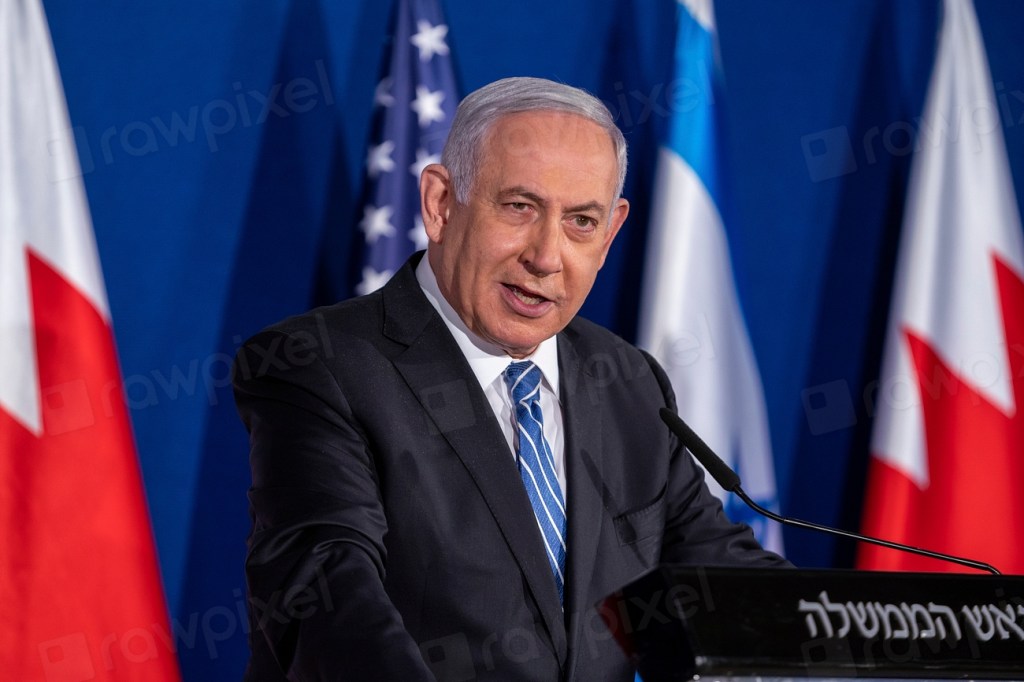
Benjamin Netanyahu has long cast himself as Israel’s unflinching helmsman, steering through the Middle East’s stormiest squalls with a steely gaze and a tactical mind. With an MIT education, combat stripes from Sayeret Matkal, and the longevity of a political cyborg, he’s carved out a legacy steeped in ambition. But legacies are fickle things. Especially when they’re built atop powder kegs you helped pack.
Act I: Playing with Matches – The Hamas Hedge
Let’s rewind to 2018. Netanyahu, ever the grandmaster, quietly nodded along as Qatar funneled cash into Gaza—first $15 million a month, later swelling to $30 million. Ostensibly, this was for humanitarian relief: bread, medicine, fuel. But the subtext was far more strategic. By ensuring Hamas had enough funds to “govern” (read: police, bicker, and scramble for legitimacy), Netanyahu undercut Palestinian unity. A fractured Palestinian front, after all, couldn’t demand statehood with any teeth.
This wasn’t a theory. He said the quiet part out loud to Likud back in 2019: “Anyone who wants to thwart the establishment of a Palestinian state has to support bolstering Hamas.” A line straight from the political Machiavelli playbook.
“Anyone who wants to thwart the establishment of a Palestinian state has to support bolstering Hamas”
Netanyahu, The Times of Israel, 2019
Only the money didn’t just go to Gaza’s infrastructure. It went into tunnels, rockets, and arms stockpiles. The cash-for-quiet strategy became a ticking time bomb. And everyone heard the timer—except, it seems, Netanyahu.
Act II: The Explosion – October 7th and the Reckoning
That time bomb detonated on October 7, 2023. In a move as shocking as it was bloody, Hamas executed a coordinated attack that left 1,200 Israelis dead and 251 kidnapped. The fallout? Catastrophic. Over 54,000 Palestinians died by mid-2025, and Israel was thrust into another grinding war.
Netanyahu’s long game had officially boomeranged. Critics across the aisle sharpened their knives. Former Defense Minister Avigdor Lieberman lambasted the policy as effectively paying “protection money” to Hamas—an unholy blend of appeasement and delusion. Netanyahu’s defense? That past IDF (Israeli Defense Forces) operations had weakened Hamas. But Gaza was burning, and the narrative smelled more like damage control than doctrine.

Act III: Fire with Fire – Arming the Clans
Having inadvertently stoked Hamas’s fire, Netanyahu pivoted once more—this time to proxy war. In June 2025, he authorized weapons transfers to anti-Hamas Palestinian factions like Yasser Abu Shabab’s Popular Forces. The logic? Let them do the dirty work. “It saves IDF soldiers,” he told reporters, trying to sell chaos as calculus.
However, empowering decentralized militias in a war zone is rarely clean. The UN has already flagged these same clans for allegedly hijacking aid convoys and contributing to famine conditions. Meanwhile, Hamas retaliates with targeted assassinations, turning Gaza into a chessboard of vengeance and vendettas. Opposition figures and security experts warn that Netanyahu may be repeating history—arming one monster to muzzle another.
The Final Act? Or Just Another Scene
All of this unfolds as Netanyahu fights for his political survival. A corruption indictment from 2019 still haunts him, and the International Criminal Court issued a war crimes warrant in 2024. His coalition government wobbles on increasingly rickety legs. The next election could mark the end of his era—or, depending on how the winds blow, a dark new chapter.
If politics is theater, Netanyahu’s tenure is a Shakespearean tragedy: bold in vision, blind in execution, and bloody in consequence. What began as a strategy to fracture Palestinian politics may ultimately fracture his legacy.
Whether he’s remembered as a brilliant tactician or a cautionary tale depends on who gets the final word—and whether anyone’s left listening.
🕰️ Timeline: Netanyahu, Hamas, and the Long Game Gone Wrong
🔹 2009–2015: Netanyahu’s Early Terms
- Benjamin Netanyahu resumes leadership of Israel in 2009.
- Maintains a strategy of weakening Palestinian Authority (PA) influence by tolerating or indirectly enabling Hamas’s control over Gaza.
🔹 2018: The Qatari Cash Pipeline Begins
- Netanyahu approves Qatari cash deliveries to Gaza.
- Monthly transfers begin at $15 million, reaching $30 million by 2021.
- Official line: humanitarian aid. Real strategy: keep Gaza and the West Bank politically divided.
🔹 March 2019: Netanyahu Says the Quiet Part Out Loud
- Publicly states: “Anyone who wants to thwart the establishment of a Palestinian state has to support bolstering Hamas.”
- Seen as a major admission of political strategy over peace process.
🔹 2021: Hamas Grows Bolder
- Armed capabilities and tunnel networks expand.
- Clashes erupt in May 2021 between Hamas and Israel; over 4,000 rockets fired from Gaza.
- Some analysts cite Qatari funds as having enabled Hamas militarization.
🔹 October 7, 2023: The Massacre
- Hamas launches a surprise, coordinated attack into Israel.
- 1,200 Israelis killed, 251 kidnapped.
- Attack exposes Israel’s intelligence blind spot—and the dangerous consequences of the cash-for-quiet doctrine.
🔹 Late 2023 – 2024: The War Escalates
- Israeli Defense Forces (IDF) respond with full-scale operations in Gaza.
- Civilian death toll rises rapidly; by mid-2025, 54,000+ Palestinians reported dead.
- Netanyahu faces backlash both domestically and abroad.
🔹 May 2024: ICC Issues Arrest Warrant
- The International Criminal Court issues war crimes warrants against Netanyahu and senior officials for actions taken during Gaza operations.
- Netanyahu rejects jurisdiction; international scrutiny deepens.
🔹 June 2025: Netanyahu’s Pivot – Arming Anti-Hamas Clans
- Israel begins supplying weapons to anti-Hamas Palestinian factions like Yasser Abu Shabab’s Popular Forces.
- Netanyahu: “It saves IDF soldiers.”
- UN warns this could deepen Gaza’s chaos; looting and famine fears rise.
🔹 Ongoing – 2025: Blowback Intensifies
- Hamas responds by assassinating rival clan members.
- Aid deliveries disrupted. UN declares parts of Gaza at famine-level risk.
- Israeli opposition and global watchdogs condemn the strategy as a reckless proxy war.
🔹 Present Day: Netanyahu Faces Mounting Pressure
Elections on the horizon may seal his fate—or plunge Israel into deeper uncertainty.
Coalition hangs by a thread; public disapproval surges.
Legal entanglements from corruption indictments (2019) and the ICC warrant (2024) cloud his future.
Key sources and Further Reading
The Times of Israel. (2019, March 10). Netanyahu said he wanted to keep Hamas in power in Gaza, video shows. https://www.timesofisrael.com/netanyahu-said-he-wanted-to-keep-hamas-in-power-in-gaza-video-shows
BBC News. (2018, November 9). Qatari cash reaches Gaza amid protests in Israel. https://www.bbc.com/news/world-middle-east-46152828
BBC News. (2023, October 7). What happened on 7 October and what is Hamas? https://www.bbc.com/news/world-middle-east-67039975
BBC News. (2025, June 5). Netanyahu confirms Israel arming clans opposed to Hamas in Gaza. https://www.bbc.com/news/world-middle-east-68930012
Netanyahu, B. (2019, March). Remarks at Likud faction meeting . As cited in Pfeffer, A. (2019, March 9). Netanyahu admits Hamas is part of strategy to thwart Palestinian statehood. Haaretz. https://www.haaretz.com/israel-news/2019-03-09/ty-article/.premium/netanyahu-admits-hamas-is-israels-tool-to-destroy-palestinians/0000017f-e3ff-df7c-a5ff-f3ff8c8c0000
Netanyahu, B. (2019, March). Statement regarding Qatari funds to Gaza As quoted in The Jerusalem Post. (2019, March 10). https://www.jpost.com/israel-news/netanyahu-qatar-money-part-of-strategy-to-split-palestinians-582409
Netanyahu, B. (2024, August). Interview with Time Magazine [Transcript]. (2024). Time Magazine. Excerpt retrieved via full-text search archive (not publicly linked).






























 Ashes on Air
Thank you for taking the time to share your thoughts. Your voice is important to us, and we truly value your input. Whether you have a question, a suggestion, or simply want to share your perspective, we’re excited to hear from you. Let’s keep the conversation going and work together to make a positive impact on our community. Looking forward to your comments!