
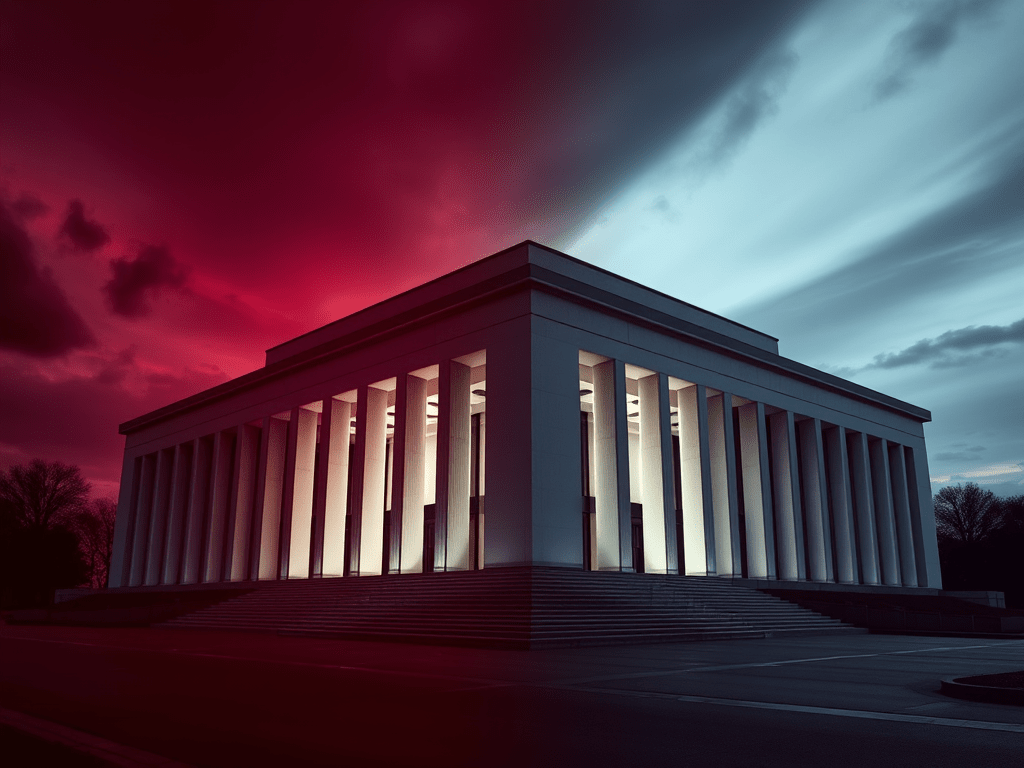
In the middle of Washington, D.C., right across from the State Department, sits a $500 million headquarters that houses a mystery: The United States Institute of Peace (USIP). Founded in 1984, it was created to put a stop to and mediate violent discord throughout the world. USIP is a federally funded nonprofit. It’s aspiring directive- Research peace, train mediators, cultivate stability in war-torn areas of the world, like the Middle East. Seems like a guiding star in the dark night, right? There’s some issues- the USIP runs under a $55.46 million annual budget, and we’re not finding many detailed answers as to what this goes too. This lack of transparency, that critics like The Heritage Foundation have long questioned, causes suspicion that the USIP may be less of guiding star, and more of a black hole. Could it be concealing inefficiencies, political agendas, or worse?
The lack of information created a disruption in trust when DOGE, busted into USIP’s headquarters with armed law enforcement. They fired practically all the staff there, and siezed USIP’s property to disseminate the institute. DOGE’s allegations against USIP? : funding terrorists, hiding weapons, and operating as “deep state” operation. On May 19th, District Judge Beryl Howell delivered a biting 102-page ruling, stating DOGE’s actions were an unlawful “gross usurpation of power.” Howell also restored USIP’s independence. The ruling may have been a legal win for USIP, but it did little to stop the questions swirling beneath it’s agenda. Why did DOGE target USIP with such ferocity? What’s the truth about it’s opaque finances and vague outcomes? Is it a peace building institution, or a front for something else? Pay attention as we dive deep into these questions, and the answers that await.
USIP’s Legal Lifeline: Why DOGE’s Takeover Was Struck Down
The legal battle over the institute’s fate began after Trump’s February 19th, 2025, executive order, that targeted agencies for “expected termination” as part of his agenda to slash federal bureaucracy. On March 14, Trump fired 11 of the institute’s 15 board members through a one sentence email. This left only canonical members: Secretary of State Marc Rubio, Defense Secretary Pete Hegseth, and National Defense University President Peter Garvin. The three of them appointed Kenneth Jackson, a DOGE-affiliated State Department official as acting president, effectively ridding the institute’s leader, George Moose. On March 17th, DOGE, facilitated by FBI agents, D.C. police, and State Department security, infiltrated USIP’s headquarters, removing staff and putting the building on lock down. Over 200 employees were terminated, and headquarters was moved to the General Serviices Adinstration (GSA) without compensation, with plans to lease it to the Department of Labor.
USIP, backed by five of the terminated, and disgruntled board members—including former U.S. Ambassador to Russia John Sullivan—sued in D.C. District Court, alleging an “unlawful assault” on its independence. The case was laid before Judge Beryl Howell, a seasoned jurist known for challenging Trump-era policies. On May 19th, 2025, Howell ruled in USIP’s favor, dismantling DOGE’s takeover with a burning critique. Her reasoning rested on five pillars:
- USIP’s Independent Status: Howell emphasized that the United States Institute of Peace Act of 1984 establishes USIP as an independent, nonprofit corporation, not an executive branch agency. While congressionally funded, USIP operates outside direct presidential control, with a 15-member bipartisan board designed to insulate it from political interference. The Act’s unique structure—12 members appointed by the president with Senate confirmation, plus three ex-officio officials—underscores its autonomy, akin to independent agencies protected by Supreme Court precedent like Humphrey’s Executor v. United States (1935) (ABC News; NPR).
- Unlawful Board Firings: The Act specifies that board members can only be removed for cause (e.g., felony conviction, malfeasance) or with approval from a board majority or four congressional committees. Trump’s unilateral firings, lacking justification or procedural compliance, violated this statute. Howell rejected the government’s claim, citing a 1985 Reagan signing statement, that the president had unrestricted removal power, noting that statutory limits override general executive authority (Washington Post; Courthouse News).
- Invalid Subsequent Actions: Because the board firings were illegal, all subsequent actions—appointing Jackson and later Nate Cavanaugh as presidents, firing Moose, terminating staff, and transferring the headquarters—were executed by “illegitimately-installed leaders” lacking legal authority. Howell declared these actions “null and void,” restoring Moose and the board (NBC News; CBS News).
- Unlawful Property Seizure: The headquarters, built with private donations and endowment funds, is owned by USIP, not the federal government. Cavanaugh’s transfer to the GSA, approved by the Office of Management and Budget on March 29, 2025, was deemed invalid due to his lack of authority. Howell affirmed USIP’s rightful ownership, nullifying the transfer (WUSA9; WIRED).
- Abusive Tactics: Howell condemned DOGE’s use of armed law enforcement from three agencies (FBI, D.C. police, State Department) to seize the building, describing it as “probably terrorizing” for staff and a “gross usurpation of power.” She highlighted threats of criminal investigations against USIP’s security chief, Colin O’Brien, and outside counsel, George Foote, as well as the coercion of USIP’s security contractor, Inter-Con, to gain access by threatening its government contracts. These tactics, she argued, were unnecessary when lawful alternatives (e.g., congressional action) existed (NPR; The Guardian).
Howell’s previous March 2025 denial of a temporary restraining order, citing “confusion” in USIP’s initial lawsuit and the lofty goal for orders such as these, had allowed DOGE’s takeover to temporarily be allowed. However, her final ruling clarified USIP’s unique status- being part of the federal government, however not part of the executive branch- which means it serves as an independent “think tank” that supports both the congress and the executive. This detail, partnered with the Act’s explicit protections, left Trump’s actions as “Unconstitutional,” and “Unlawful.”
Following the Money Trail: How Does the Budget Actually get Spent?
While Howell’s ruling exonerated USIP’s legal standing, it still did not address the opacity that made it a prime suspect for DOGE in the first place. The $55.46 million FY 2025 budget, primarily from Congress, funds “peace research, education, training, and field programs.” However, what those are exactly? Unfortunately they are left to speculation. This sets a flame to distrust among professional critics, and the public alike. Where’s the accountability? Even The Heritage Foundation’s 2024 report condemned USIP for their “politicized and unaccountable” spending. A sentiment that social media users echo.
Financial Opacity
USIP’s budget lacks public punch. By law, 25% ($13.86 million) must fund grants and contracts for peace research and education by nonprofits and public institutions, such as the Kroc Institute or Minerva-USIP fellowships for 19 Ph.D. researchers in 2024-2025 (USIP: Budget; DoD). The remaining ~$41.6 million is estimated to cover:
- Salaries: ~$30 million for 300 employees (average $100,000, including benefits), reasonable for D.C. think tanks but high for an organization with unclear impact (The Guardian).
- Operations: ~$11.6 million for the $500 million headquarters (built with private funds), travel, and field offices in places like Kabul.
Yet, USIP’s Congressional Budget Justification offers only broad “priorities,” not itemized spending. Unlike typical nonprofits, it’s exempt from filing public IRS Form 990s, and a 2000 paperwork reduction act reportedly waived requirements for annual audits or biennial program reports (Heritage Foundation). While Government Accountability Office (GAO) audits occur, none from 2020-2025 flag misconduct, but their details aren’t public, leaving taxpayers in the dark (USIP: About).

Missing Outcome Metrics
USIP’s peace research and education—studying conflict causes and training mediators—are well-documented but lack measurable impact. Examples include:
- Research: Reports on climate-driven conflicts inform USAID’s Sahel programs, and a 1999 study on diplomatic failures shapes early warning systems (USIP: About). The PeaceTech Lab’s 2023 tool countered Nigerian election disinformation (InterAction).
- Education: USIP trained 1,200 mediators in 2024, including UN peacekeepers, and facilitated 2023 South Sudan dialogues with 20-30 leaders to curb hate speech (USIP: Budget). Its Tunisia training (2010s) supported a democratic transition, earning a 2015 Nobel nod (USIP: About).
However, USIP rarely quantifies outcomes. Did South Sudan’s dialogues reduce violence? Did Nigerian tools lower election clashes? Only Tunisia offers clear impact, an outlier. It’s no wonder why conjecture about the institute exist.
Why the Suspicion?
This lack of transparency invites speculation about hidden agendas:
- Inefficiency: Vague reporting may conceal a bloated bureaucracy, with $30 million in salaries and a lavish headquarters prioritizing self-preservation over peacebuilding.
- Favoritism: Undisclosed grant recipients (beyond known cases like the Kroc Institute) raise concerns about funds flowing to connected entities (USIP: Budget).
- Covert Roles: DOGE’s debunked claims of terrorism funding ($132,000 to an ex-Taliban member) and weapons reflect fears that field operations hide intelligence activities, though USIP’s academic profile makes this unlikely (Snopes; [X post: 6]).
On social media, users amplify these fears, alleging private jets and Taliban contracts, while @RepDonBeyer defends USIP’s independence, highlighting DOGE’s overreach. The truth likely lies in bureaucratic inertia—USIP’s hybrid status (nonprofit yet federally funded) allows it to fall through the cracks, creating distrust without evidence of major misconduct.
DOGE’s Crusade: Motives and Missteps
The Trump administration’s action regarding the Institute, was part of a broader agenda characterized by an emphasis on “America First” policies. There were members that expressed worry about USIP’s $55.46 million dollar budget. The concern was expressed as it lacked efficient oversight, and stating that a lot of the same actions could be provided by USAID, and the State Department. This eventually led to calls for potential reform.
The driving factors behind the administration’s actions included:
- Financial Considerations: The bleak and opaque budget concerns addressed, they thought maybe the building could be put to better use.
- Claims of Misconduct: Allegations were claimed about the funding behind USIP’s budget. Some thought this could rally support among certain political bases. The claims were “de-bunked” by fact-checking organizations (But, who is running these?…next deep dive?)
- Legal Misinterpretation: Debates regarding the legal status of USIP emerged. The administration though it had executive power over the nonprofit organization, a point that Howell ruled as incorrect.
The attempt made by DOGE to reform USIP created questions about how appropriate the actions were, that they took. Observers took note that the moves made could have been viewed as hostile or misdirected. This in turn, caused critiques of DOGE’s techniques, and motivations. The effects of the operation caused stress on the individuals, and the institution. This highlights the complexities of policy disputes in a politically charged climate.
What’s Really Going On?
With all the drama encapsulating USIP and DOGE, there sparks a question: What is the United States Institute of peace actually doing with it’s extensive budget, and why does it have to be so difficult to find out? The institute’s actions-the research, the training, the foreign running program (like South Sudan)- are supposedly done to prevent violence, but it’s elusive reporting and vague outcomes, spur doubts about it’s efficiency. Even though DOGE’s actions were ruled unlawful, there is still an air of genuine concerns about government spending and oversight.
USIP’s mission, rooted in the 1984 United States Institute of Peace Act, is to foster peace through research, education, and on-the-ground efforts. Its $55.46 million FY 2025 budget supports activities like analyzing climate-driven conflicts in the Sahel, which informs USAID’s aid strategies, and training 1,200 mediators in 2024, including UN peacekeepers for missions in South Sudan (USIP: Budget; InterAction). A standout success was its role in Tunisia’s 2010s democratic transition, where training for civil society mediators contributed to the 2015 Nobel Peace Prize for the National Dialogue Quartet (USIP: About). Yet, most programs, like the 2023 South Sudan dialogues with 20-30 leaders to curb hate speech, lack data on whether they reduced violence, leaving observers questioning their impact (USIP: About).
Financially, USIP’s budget is a closed door, with only it’s executives knowing the truth. At least 25% ($13.86 million) funds grants for peace research and education, such as the 2024-2025 Minerva-USIP fellowships for 19 Ph.D. researchers studying conflict dynamics (DoD). The rest—roughly $30 million for 300 employees’ salaries (averaging $100,000 each) and $11.6 million for operations, including the $500 million headquarters—lacks detailed public breakdowns (The Guardian; Wikipedia). USIP’s exemption from filing IRS Form 990s and limited public audits, due to a 2000 paperwork reduction act, (Can’t they just keep track on the cloud? Technology is a game changer…::Wink:::) further obscures its spending, as no Government Accountability Office reports from 2020-2025 are publicly available (Heritage Foundation). This vagueness, coupled with high overhead costs, prompts questions about whether funds are used efficiently or prioritized for peacebuilding.
DOGE’s takeover, led by Elon Musk and Vivek Ramaswamy, was a calculated move shaped by Trump’s “America First” policy and concerns among some in his administration that USIP’s budget lacked oversight and its functions overlapped with USAID and the State Department, suggesting redundancy (USIP: Budget). These critics saw USIP as emblematic of bloated federal spending, with its hybrid status—congressionally funded yet nonprofit—raising doubts about accountability. DOGE’s allegations of USIP funding terrorism (e.g., $132,000 to an alleged ex-Taliban member) or hiding weapons were widely circulated on X but lacked evidence, as investigations found no substantiation (Snopes; [X post: 6]). The $500 million headquarters transfer to the GSA, later voided, suggests an interest in reclaiming valuable assets, though the court ruled it unlawful (WUSA9).
Public views reflect divide. Some, question USIP’s spending, asking how millions can just disappear, without any verifiable results. Others criticize Trump’s administration of government overreach. Myself, I’m wondering why they are hiding the information on the programs they are utilizing the budget for, wouldn’t that be something to be proud and transparent about, if they are using it for the right reasons? If they have created so much peace, why not share their tactics? On the other hand, the optics of DOGE coming in hot with FBI, to a peace institute, really doesn’t look good on them either.
The Path Forward
The USIP-DOGE saga underscores a broader challenge: balancing institutional autonomy with public accountability. USIP’s work—researching peace, training mediators, fostering dialogue—holds potential, as seen in Tunisia’s success, but its opacity risks eroding trust. Detailed budget reports, public grant recipient lists, and outcome metrics, even if qualitative, could clarify its value. For critics like those behind DOGE, the episode highlights the need for evidence-based reforms rather than unilateral actions, which Judge Howell’s ruling firmly rejected (ABC News). As USIP rebuilds, its ability to address these concerns will determine whether it emerges as a trusted peacemaker or remains shadowed by doubt, a question that resonates far beyond Washington’s corridors.
Sources List
- Heritage Foundation: The U.S. Institute of Peace Is Politicized and Unaccountable
- USIP: About USIP
- USIP: FY 2025 Budget in Brief
- The Hill: US Institute of Peace sues DOGE over takeover attempt
- NPR: Federal judge denies request to block DOGE takeover of U.S. Institute of Peace
- NPR: Judge declines to immediately reverse Trump moves at U.S. Institute of Peace
- NPR: Federal judge blocks Trump’s takeover of U.S. Institute of Peace
- The Guardian: Most employees at US Institute of Peace mass-fired via late-night email
- CBS News: Judge rules DOGE dismantling US Institute of Peace illegal
- ABC News: Judge rules DOGE takeover of US Institute of Peace unlawful
- Department of Defense: 2024-2025 Minerva-USIP Peace and Security Fellows
- WIRED: DOGE US Institute of Peace building takeover
- Washington Post: Judge blocks Trump’s US Institute of Peace takeover
- Washington Post: DOGE takeover attempt at US Institute of Peace
- WUSA9: Trump administration takes $500M US Institute of Peace building for free
- Note: USIP website is down most of the time, even when using the “way back machine: web.archive -you may receive a “Sorry, you have been blocked” error page.




 Ashes on Air
Thank you for taking the time to share your thoughts. Your voice is important to us, and we truly value your input. Whether you have a question, a suggestion, or simply want to share your perspective, we’re excited to hear from you. Let’s keep the conversation going and work together to make a positive impact on our community. Looking forward to your comments!