
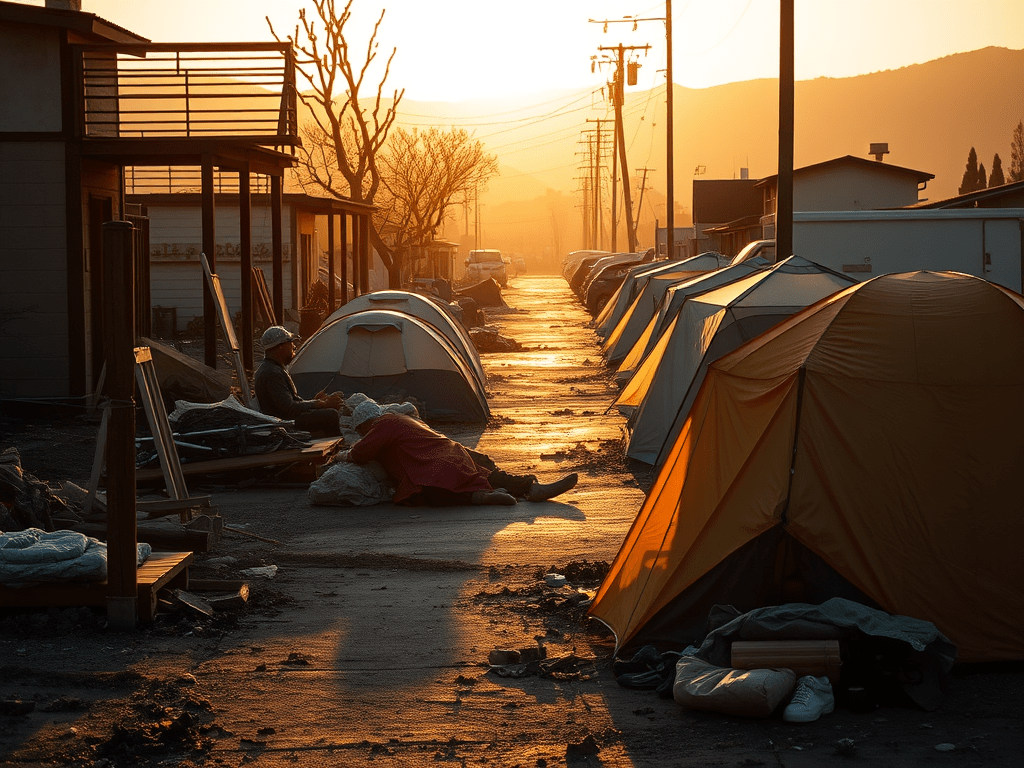
The scars of January’s Los Angeles wildfires still dig deep. Imagine your home’s gone, reduced to ash, and you’re sleeping on a sidewalk—until police clear your tent for being “unattractive.” This is life for thousands in California, where 12,000 homes burned, 150,000 people were displaced, and the state’s homelessness crisis—already 181,399 strong in 2023—exploded. Something’s wrong with this picture. We’ve all seen the devastation that the Palisade’s fire caused. When you’ve lost everything, and it seems like it can’t possibly get any worse, here comes good ole’ governor Gavin Newsom to punish you just for surviving. His $27 billion plan and May 2025 encampment ban promise action, but are they just a simple band-aid? Let’s dive into what FEMA and the Los Angeles Homeless Services Authority (LAHSA) are delivering—and what they’re lacking.
The Crisis Ignited
The wildfires—Palisades, Eaton, Hurst—torched 40,000 acres, leaving LA County’s 75,000 unhoused and newly displaced fighting for scraps. Newsom’s crackdown, backed by a 2024 Supreme Court ruling letting cities penalize sleeping outside, clears tents but doesn’t build homes. Where is one supposed to sleep? His Homekey program, turning motels into 7,000 housing units, is a start, but California needs 1.2 million affordable homes by 2030. With only 27,000 shelter beds pre-fire, it’s like squeezing the ocean into a teacup. Now, add 10,000–20,000 more homeless from the fires. What’s being done, and why isn’t it working?
What Survivors Are Getting
FEMA and LAHSA (LA’s Homeless Services Authority,) are the main lifelines, but their aid varies for homeowners, renters, and the unhoused. Here’s the breakdown, straight from the ground.
FEMA: Disaster Relief in Action
Since President Biden’s January 8, 2025, disaster declaration, FEMA’s been hustling, with over $2 billion disbursed by March 26, 2025, across 24,000+ applications. If you’re an individual who has lost their home due to the fire, here’s what you “might” get:
- Grants: Nontaxable, no-repayment funds for uninsured losses—think hotel stays, home repairs, or replacing clothes and meds. Average grant? About $9,578, based on past wildfires. A one-time $300 payment helps clean livable homes. $300! What are you supposed to do with $300? $300 can barely cover a trip to the grocery store these days.
- Temporary Housing: Cash for rentals or hotel reimbursements. No direct apartment leasing like Maui 2023, though—FEMA says LA’s market is “fine,” despite 3–5% vacancies and $1,800–$2,500 rents. It’s “fine” everything is “fine”…
- Disaster Recovery Centers (DRCs): Altadena and UCLA hubs saw 12,641 visits by February, offering application help, accessible with multilingual support. Text “DRC” and your ZIP to 43362 or call 1-800-621-3362. Don’t expect direct human support, and if you’re going to go to their offices, be prepared to stand in line.
- Crisis Support: The Disaster Distress Helpline (1-800-985-5990) offers 24/7 counseling. Disaster Unemployment Assistance helps self-employed or jobless survivors until March 31, 2025. (Which of course, has already passed)
- Application Ease: Apply at DisasterAssistance.gov, via the FEMA app, or at DRCs by March 31, 2025. You’ll need a Social Security number, damage details, and insurance denial proof. (Because proof is just so easy to obtain when you don’t have a mailbox, right? Is the fact that everything is still in embers enough proof?)
LAHSA: Homelessness Response
LAHSA, serving LA’s 75,312 unhoused (2024 count), stepped up for fire victims and the pre-existing unhoused. Great, now we can all fight over turf. Their efforts include:
- Relocation: Moved 275 people from five interim housing sites during evacuations, issuing 645 motel vouchers for temporary stays. Because…it’s better than nothing? How do they choose?
- FEMA Help: Guides unhoused with prior housing (e.g., shelters) to apply for FEMA aid, though it’s tougher for those without addresses. No kidding-isn’t this what you’re supposed to be helping with?
- Health Measures: Handed out thousands of N95 masks to shield against toxic smoke (asbestos, lead), vital for Skid Row’s 2,200 unsheltered. That’s awesome, now we can all not breathe together!
- Outreach: Teams hit burn zones with first responders, linking people to mental health, addiction treatment, or jobs via coordinated entry systems (10,000 served yearly). Yet there is over a quarter of a million unhoused.
- Homeless Count: Delayed the 2025 count to February 18–20, using outreach workers in fire zones for safety, aiming for 8,000 volunteers to track trends. Because, when you’re exhausted and fighting for survival every day, who doesn’t want to volunteer?
What’s Missing: The Gaps That Hurt
I’ve seen the desperation in people’s eyes. FEMA and LAHSA are trying, but the system’s creaking. Here’s what’s lacking.
FEMA’s Shortfalls
- No Long-Term Housing: Grants cover weeks, not years, but LA’s 500,000-unit shortage and sky-high rents block permanent homes. Unlike Maui, no direct leasing means renters hunt in a cutthroat market. Post-2023 Maui fires saw an 87% homelessness spike—LA’s next if this continues.
- Unhoused Left Out: FEMA prioritizes those with primary residences, sidelining Skid Row’s unsheltered. Without addresses, they miss grants, facing sweeps and toxic smoke (12% of wildfire ER visits, per UC San Diego).
- Red Tape: Insurance-first rules and document demands (e.g., Social Security, damage proof) delay aid. Appeals are complex, though groups like LAFLA help. A 2019 GAO report called FEMA’s wildfire process “onerous”—still true.
- Underfunded: The fires’ $250 billion damage dwarfs FEMA’s $2 billion. Historic $270 million for wildfire aid (2015–2024) shows they’re stretched thin.
LAHSA’s Limits
- Shelter Crunch: Only 27,000 beds for 75,312 unhoused, now swamped by 150,000 fire displacees. Fire victims get priority, leaving pre-fire unhoused like Sean on the streets, facing Newsom’s sweeps (80% of swept stay unhoused, per 2024 study). Somehow, it’s “illegal” to be homeless though. So where are people supposed to sleep?
- Resource Drain: Fires divert funds from homelessness—LA’s budget crisis (legal payouts, labor costs) cuts services. Nonprofits like Union Station, with burned sites, are overwhelmed.
- Service Gaps: Mental health and addiction support (needed by 66% of unhoused) are underfunded. LAHSA’s 10,000 annual CES connections can’t keep up.
A Personal Lens
Walking down Skid Row, talk to any of these people. These aren’t stats—they’re people, and the system’s failing them. Newsom’s crackdown feels more guided towards optics, and less to do with empathy. When shelters are bursting at the seams, and FEMA’s grants don’t stretch. I’ve seen resilience in their eyes, but it’s tested by a game rigged against them.
Expert Voices and a New Idea
Dr. Margot Kushel, a UCSF expert, nails it: “Sweeps hide homelessness, not solve it. Housing does.” Houston cut homelessness 63% with Housing First—permanent homes, no hoops. California’s 24 supportive housing units per 100 eligible households scream neglect. Here’s my pitch: treat homelessness like a disaster. Newsom fast-tracked $100 million for fire relief—why not do the same for housing? FEMA could pilot $500–$1,000 micro-grants for the unhoused to replace tents or IDs, no address needed. LAHSA could reserve shelter beds for pre-fire unhoused, using FEMA’s hotel model to expand. It’s not rocket science—it’s will.
What You Can Do
If you’re in LA, fighting like Maria or Sean, here’s your playbook:
- Grab FEMA Aid: Apply at DisasterAssistance.gov, 1-800-621-3362, or DRCs by March 31, 2025. File insurance claims first, keep receipts, appeal denials.
- Connect with LAHSA: Call 211 or visit lahsa.org for motel vouchers, CES, or masks. Nonprofits like Hope the Mission help.
- Stay Safe: Secure IDs—sweeps destroy them. Get N95s from LAHSA for smoke. Call 1-800-985-5990 for crisis support.
- Fight Back: Legal aid challenges illegal sweeps. Know your rights.
A Call to Rebuild Smarter
The ashes of 2025 can spark change, but not if we keep sweeping people under the rug. You—yes, you—can demand better. Push for Housing First, not handcuffs. Support zoning reform to build 1.2 million homes. Listen to the people going through this. They don’t need pity; they need a hand up. Got a story? Share it with Ashes on Air. We’re listening.
For resources, visit lahsa.org or fema.gov.




 Ashes on Air
Thank you for taking the time to share your thoughts. Your voice is important to us, and we truly value your input. Whether you have a question, a suggestion, or simply want to share your perspective, we’re excited to hear from you. Let’s keep the conversation going and work together to make a positive impact on our community. Looking forward to your comments!