

Before the U.S. government formed in 1789 under the Constitution, no formal political parties existed; factions emerged during the Revolution and Confederation era, solidifying into Federalists and Democratic-Republicans in the 1790s. The presidency was established by Article II, creating an elected executive to lead, balance powers, and serve a four-year term, evolving from colonial governance models. Here are the key milestones, obstacles, lessons, era facts, and farewell reflections of the first five U.S. presidents, presented factually.
George Washington (1789-1797, 2 terms, No Party/Federalist-leaning)
“It is far better to be alone than to be in bad company.” (A widely cited Washington quote, often attributed to his personal writings)
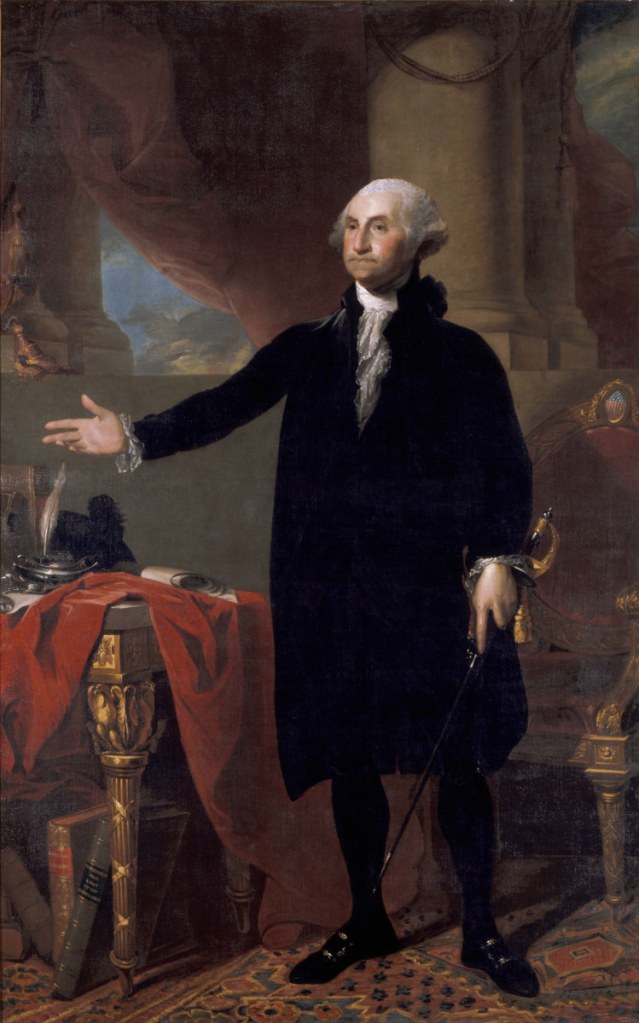
Portrait by Gilbert Stuart in 1797. Oil on canvas, 95 x 59 13/16 inches.
White House Collection/White House Historical Association
Milestones:
- Set Presidential Precedent: Established the executive role with a focus on restraint, influencing future leadership.
- Signed Bill of Rights: Enacted the first 10 amendments, defining individual freedoms in the Constitution.
- Created First Bank: Introduced a national bank to stabilize the economy, despite opposition.
- Signed Jay Treaty: Secured a peace agreement with Britain, maintaining trade despite public criticism.
- Launched Washington, D.C.: Oversaw planning of the new capital, aiming to unify the nation.
- Quelled Whiskey Rebellion: Enforced federal authority against tax protesters in Pennsylvania, reinforcing central power.
- Proclaimed Neutrality: Kept the U.S. out of European conflicts, maintaining stability in early years.
- Formed Cabinet: Established key advisory roles, setting a tradition for executive governance.
- Appointed First Chief Justice: Named John Jay to lead the Supreme Court, grounding the judiciary.
- Delivered Farewell Address: Cautioned against division and foreign alliances, shaping future policy.
Obstacles:
- Did Not Address Slavery: Owned slaves and did not pursue abolition, maintaining the status quo.
- Oversaw Native Conflicts: Supported military campaigns in the Northwest, leading to tribal displacement.
- Contributed to Partisanship: Policies led to Federalist-Republican divides, increasing political tensions.
- Mishandled Genet Affair: Mismanaged a French envoy’s actions, straining diplomatic relations.
- Signed Unpopular Jay Treaty: Agreement with Britain drew public criticism for perceived leniency.
- Faced Panic of 1792: Economic downturn affected farmers and traders during his term.
- Did Not Support Haiti’s Revolution: Declined to aid enslaved rebels, conflicting with liberty principles.
- Showed Pro-British Neutrality: Neutrality policy favored Britain, causing friction with France.
- Prioritized Elite Economic Interests: Economic policies often benefited the wealthy, overlooking others.
- Left Foreign Policy Unstable: Early diplomatic decisions created challenges for U.S. global relations.
Lessons:
- Leadership establishes governance standards; ignoring systemic issues can lead to future conflicts.
- Defining rights shapes legal frameworks; displacing native groups creates lasting tensions.
- Economic measures impact stability; political divides can grow from policy decisions.
- Diplomacy affects international standing; mismanaging relations can weaken trust.
- National symbols unify; economic policies can deepen social divides if not balanced.
Era Facts:
- Washington was an enthusiastic dog breeder, particularly of hunting hounds, giving them names like “Sweet Lips” and “Drunkard.”
- He grew hemp at Mount Vernon for industrial purposes, such as making rope, not for recreational use.
- Washington was the only president to win a unanimous Electoral College vote, reflecting his widespread respect.
- He survived smallpox as a young man, which left his face scarred but built his immunity.
- Washington’s false teeth were not wooden but made from materials like ivory and human teeth, a common practice then.
Farewell Reflections:
“The unity of government which constitutes you one people is also now dear to you. It is justly so, for it is a main pillar in the edifice of your real independence.” (From his Farewell Address, 1796)
John Adams (1797-1801, 1 term, Federalist)
“Facts are stubborn things; and whatever may be our wishes, our inclinations, or the dictates of our passions, they cannot alter the state of facts and evidence.” (From his defense in the Boston Massacre trial, 1770, a widely recognized Adams quote)
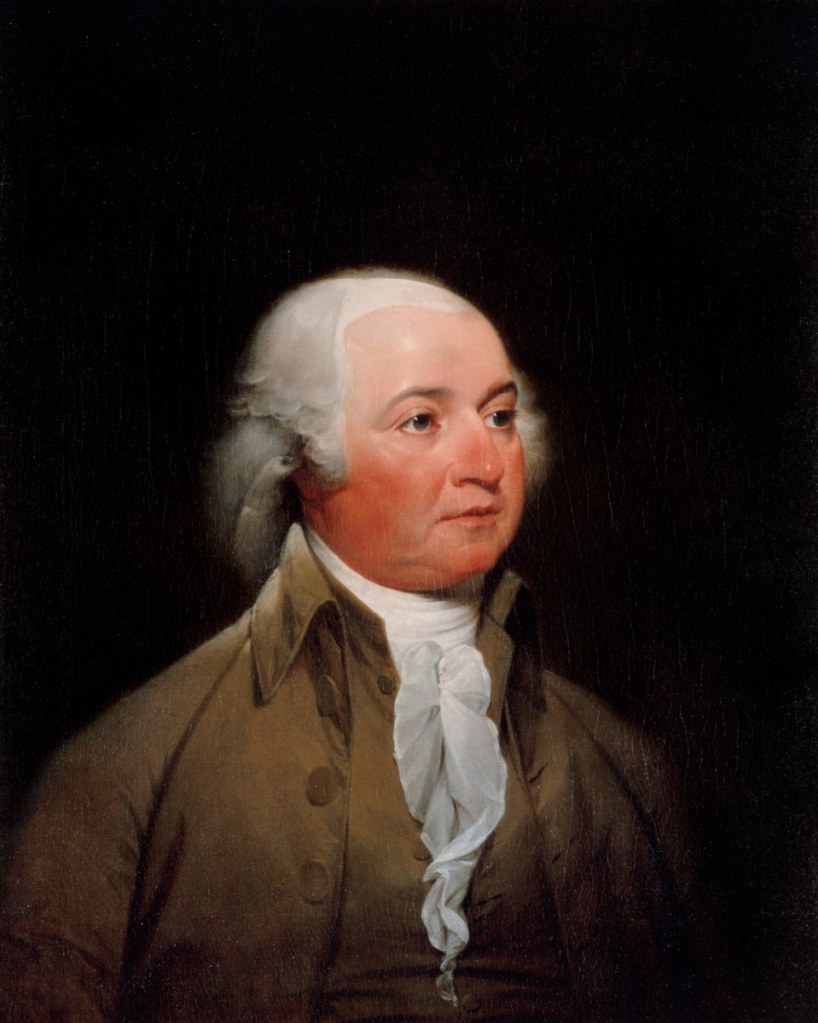
Portrait by John Trumbull ca. 1792-1793. Oil on canvas, 30 1/16 x 24 inches.
White House Collection/White House Historical Association
Milestones:
- Built U.S. Navy: Expanded naval forces to counter French threats, protecting trade routes.
- Avoided French War: Negotiated peace during the Quasi-War, preventing conflict.
- Founded Library of Congress: Established a national library, supporting knowledge preservation.
- Passed Judiciary Act: Expanded federal courts, strengthening the judicial system.
Obstacles:
- Signed Alien and Sedition Acts: Laws restricted free speech, leading to arrests of critics and immigrants.
- Mishandled XYZ Affair: Bribery scandal with France damaged public trust in his administration.
- Lost Public Support: Policies reduced his popularity, contributing to his re-election loss.
- Deepened Federalist Divides: Actions alienated party members, weakening political cohesion.
Lessons:
- Military expansion secures trade; restricting speech can harm public trust.
- Diplomacy can avert war; foreign scandals impact credibility.
- Knowledge institutions foster growth; popularity affects leadership longevity.
- Judicial systems require structure; internal party conflicts hinder governance.
- Preparation mitigates crises; overreach can fracture alliances.
Era Facts:
- Adams was the first president to live in the White House, moving in during 1800.
- He and Jefferson were close friends, then rivals, but reconciled later, dying on the same day—July 4, 1826.
- Adams wrote extensively, leaving behind a detailed diary of his life and presidency.
- He was known for his temper, often clashing with political allies and opponents alike.
- Adams’ son, John Quincy Adams, became the sixth president, marking the first father-son presidential duo.
Farewell Reflections:
“The great volume of human nature is unrolled before me, and I have learned to distinguish the good from the evil.” (From a letter near the end of his term, 1801, as no formal farewell address exists)
Thomas Jefferson (1801-1809, 2 terms, Democratic-Republican)
“We hold these truths to be self-evident, that all men are created equal.” (From the Declaration of Independence, 1776, Jefferson’s most famous quote)

Portrait by Rembrandt Peale in 1800. Oil on canvas, 23 1/8 x 19 1/4 inches.
White House Collection/White House Historical Association
Milestones:
- Secured Louisiana Purchase: Doubled U.S. territory, enabling westward expansion.
- Launched Lewis and Clark: Initiated expedition to map the frontier, supporting exploration.
- Cut Taxes: Reduced federal taxes, aiming to ease financial burdens on citizens.
- Shrank Government: Decreased federal size, aligning with limited-government principles.
Obstacles:
- Enacted Embargo Act: Halted trade, causing economic hardship for merchants and farmers.
- Owned Slaves Despite Liberty Stance: Advocated freedom while enslaving hundreds, creating inconsistency.
- Mishandled Foreign Relations: Embargo strained ties with Britain and France.
- Ignored Infrastructure: Did not prioritize roads and canals, limiting development.
Lessons:
- Territorial expansion shapes growth; trade restrictions can harm economies.
- Exploration advances knowledge; inconsistent principles undermine credibility.
- Tax reductions impact citizens; foreign policy affects international relations.
- Government size influences efficiency; infrastructure neglect slows progress.
- Policy decisions reflect values; actions must align with stated beliefs.
Era Facts:
- Jefferson designed his own tombstone, listing only three achievements: authoring the Declaration of Independence, founding the University of Virginia, and writing the Virginia Statute for Religious Freedom.
- He was an avid inventor, creating a polygraph device to duplicate letters and a revolving book stand.
- Jefferson kept a pet mockingbird named Dick, which often sang while he worked.
- He doubled the size of the Library of Congress by selling his personal book collection to it in 1815.
- Jefferson was a skilled violinist and often played music to relax at Monticello.
Farewell Reflections:
“I leave to my fellow-citizens the care of those rights which I have enjoyed.” (From a letter near the end of his term, 1809, as no formal farewell address exists)
James Madison (1809-1817, 2 terms, Democratic-Republican)
“If men were angels, no government would be necessary.” (From Federalist No. 51, 1788, one of Madison’s most famous quotes)
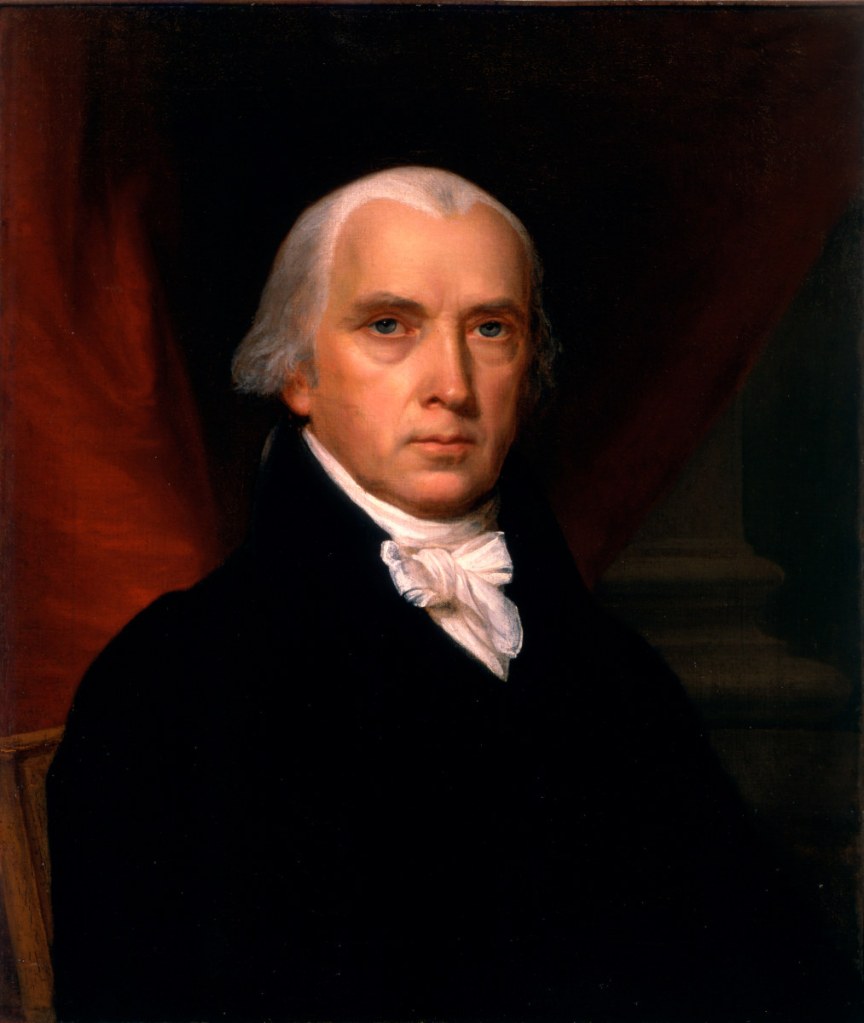
Portrait by John Vanderlyn in 1816. Oil on canvas, 26 x 22 3/16 inches.
White House Collection/White House Historical Association
Milestones:
- Won War of 1812: Led the U.S. to victory against Britain, affirming national strength.
- Chartered Second Bank: Established a national bank to stabilize postwar finances.
- Boosted Nationalism: War success fostered a sense of unity and national identity.
Obstacles:
- Botched War Prep: Left the U.S. unprepared for early British victories in the War of 1812.
- Saw D.C. Burn: Failed to protect the capital, which British forces burned in 1814.
- Alienated New England: War policies led to regional dissent and secession talks.
- Mismanaged Finances: War debts accumulated, complicating economic recovery.
Lessons:
- Military victories enhance national pride; preparation impacts conflict outcomes.
- Financial institutions aid recovery; protecting key assets is critical.
- Unity can stem from conflict; regional divisions weaken cohesion.
- Resilience shapes outcomes; debt management affects stability.
- National identity evolves; strategic planning prevents setbacks.
Era Facts:
- At 5 feet 4 inches and about 100 pounds, Madison was the smallest U.S. president in stature.
- He was known as the “Father of the Constitution” for his key role in its drafting.
- Madison suffered from epilepsy, experiencing seizures throughout his life.
- His wife, Dolley Madison, was renowned for her social skills, hosting influential White House gatherings.
- Madison was the first president to wear long trousers instead of knee breeches, reflecting a shift in fashion.
Farewell Reflections:
“The advice nearest to my heart and deepest in my convictions is that the Union of the States be cherished.” (From his final annual message to Congress, 1817, as no formal farewell address exists)
James Monroe (1817-1825, 2 terms, Democratic-Republican)
“National honor is national property of the highest value.” (From his first inaugural address, 1817, a widely recognized Monroe quote)
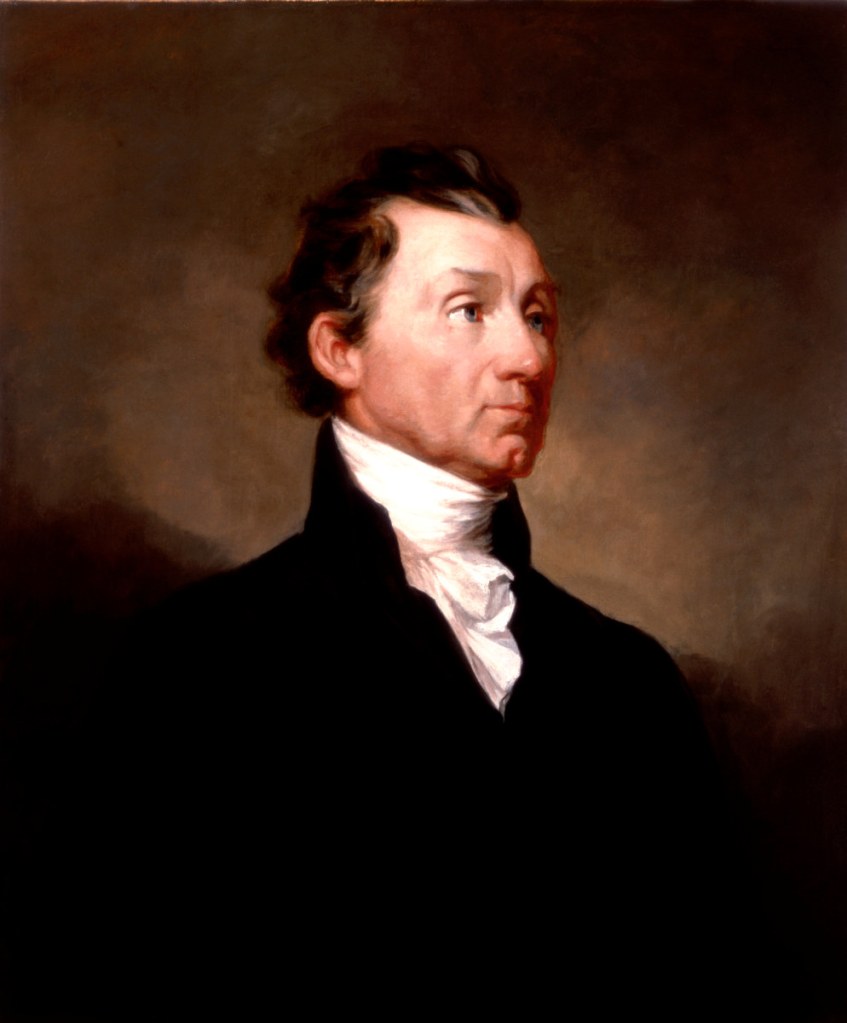
Portrait by Samuel F. B. Morse ca. 1819. Oil on canvas, 29 5/8 x 24 5/8 inches.
White House Collection/White House Historical Association
Milestones:
- Issued Monroe Doctrine: Declared the Americas off-limits to European colonization, asserting U.S. influence.
- Acquired Florida: Secured territory from Spain, expanding U.S. borders.
- Oversaw Missouri Compromise: Balanced slave and free states, postponing sectional conflict.
Obstacles:
- Ignored Slavery’s Divide: Compromise avoided addressing slavery’s core issues, delaying resolution.
- Faced Panic of 1819: Economic downturn impacted farmers and workers during his term.
- Neglected Native Americans: Policies displaced tribes with minimal support.
Lessons:
- Foreign policy shapes influence; unresolved issues can escalate.
- Territorial gains expand reach; economic downturns require response.
- Compromises delay conflict; native displacement has lasting effects.
- Regional balance affects unity; short-term solutions impact the future.
- National growth involves trade-offs; policy decisions affect citizens.
Era Facts:
- Monroe was the only president besides Washington to run essentially unopposed, winning re-election in 1820.
- He was the last president to wear a powdered wig, a style from the Revolutionary era.
- Monroe fought in the Revolutionary War, surviving a near-fatal wound at the Battle of Trenton.
- His daughter, Maria, was the first to be married in the White House in 1820.
- Monroe died on July 4, 1831, the third president to pass away on Independence Day.
Farewell Reflections:
“The period of trial is past, and that of peace and prosperity has commenced.” (From his final annual message to Congress, 1824, as no formal farewell address exists)
Understanding Political Parties in Early America
The early U.S. political landscape featured shifting party affiliations:
- No Party/Federalist-leaning: Washington avoided formal parties but aligned with Federalist ideas, favoring strong central governance.
- Federalist: Led by Adams, this party supported a strong federal government, a national bank, and close ties with Britain.
- Democratic-Republican: Backed by Jefferson and Madison, it championed states’ rights, agrarian interests, and limited federal power.
- National Republican: A short-lived offshoot under Adams, it focused on infrastructure and economic development.
- Democratic: Jackson’s party emphasized populism and expanded voting rights, often prioritizing common citizens.
- Whig: Harrison and Tyler’s initial party advocated modernization and opposed executive overreach, though Tyler broke away.
- Independent: Tyler’s later stance reflected his split from the Whigs, focusing on personal policy priorities.
Sources:
- National Archives
- White House
- Encyclopedia Britannica
- History.com
- Mount Vernon
- Naval History and Heritage Command
- Library of Congress
- U.S. Senate
- U.S. Department of State
- National Park Service
- U.S. Treasury
- Supreme Court
- Monticello
- Reader’s Digest
- White House Historical Association Presidential Portraits




 Ashes on Air
Thank you for taking the time to share your thoughts. Your voice is important to us, and we truly value your input. Whether you have a question, a suggestion, or simply want to share your perspective, we’re excited to hear from you. Let’s keep the conversation going and work together to make a positive impact on our community. Looking forward to your comments!