
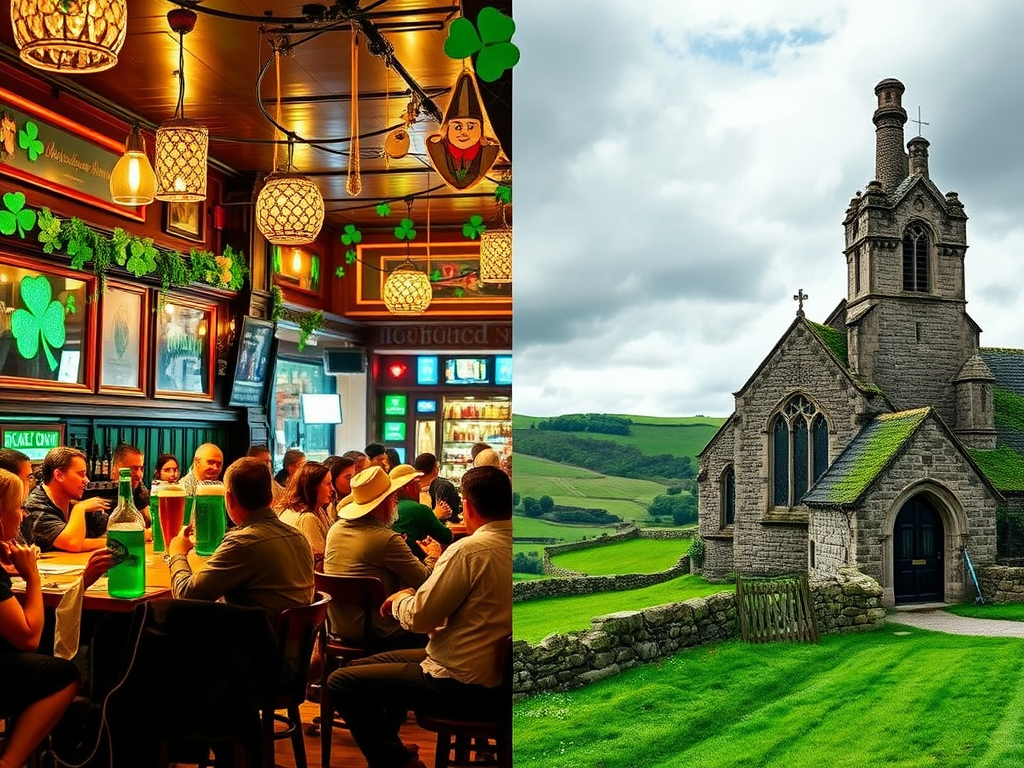
Monday, March 17, 2025, PST – St. Patrick’s legacy spans 1,564 years, yet today, America celebrates with green beer and pinches while Ireland reflects on its heritage. How did one saint’s story diverge into two distinct worlds?
As we wind down our day on March 17, 2025, establishments across the United States hum with the remnants of celebration. Green beer lingers in glasses, leprechaun motifs fade from tabletops, and the last playful pinches subside. St. Patrick’s Day stands as one of America’s most spirited occasions, a vivid departure from the solemn observance it began as in Ireland 1,564 years ago. Patrons of all kinds—enthusiastic drinkers and sober observers alike—have joined the festivities, yet few recognize that St. Patrick was not Irish by birth, no snakes were ever expelled, and Ireland’s commemoration contrasts sharply with the vibrant spectacle that has unfolded nationwide. This exploration traces the journey from a 5th-century missionary’s trials to the modern traditions of shamrocks, green libations, and communal cheer, revealing a narrative more compelling than the celebration itself.
St. Patrick: A Life Beyond the Legends
Consider the late 4th century: Roman Britain, a rugged frontier of the waning empire, devoid of modern conveniences, illuminated only by firelight. Around 385 CE, a 16-year-old named Patrick was abducted by Irish raiders and transported across the Irish Sea. “I was taken captive,” he later recorded in his Confessio, a candid document accessible online, offering a rare window into his experience. For six years, he tended sheep in Ireland, isolated and sustained by fervent prayer. A divine vision prompted his escape: “Run to the coast,” it urged. He complied, secured passage on a vessel, and returned to Britain. Decades later, ordained as a missionary, he chose to revisit Ireland—not out of vengeance, but to introduce Christianity to his former captors. His death on March 17, 461 CE, in County Down, marks a pivotal moment—1,564 years ago today (2025 – 461 = 1,564). The designation CE, or “Common Era,” aligns with AD but adopts a secular framing, placing Patrick’s demise 461 years after the conventional start of the calendar, an epoch of rudimentary shelters rather than urban sprawl.
In his own words, distilled for clarity: “I was young and reckless, captured, forced to tend livestock; faith guided my escape, and I returned to serve.” The Confessio is unembellished, a testament to resilience rather than a recounting of miracles. It mentions neither shamrocks nor snakes—only the stark reality of his transformation. Ireland embraced him as its patron saint, not through formal canonization (a practice not yet standardized), but through enduring reverence for his steadfast mission.

Debunking the Serpent Saga
“St. Patrick banished the snakes!” echoes through today’s revelry. This is a misconception. Ireland has never harbored snakes, a fact substantiated by geological evidence: since the last Ice Age, its insular geography has precluded reptilian inhabitants Geological Survey Ireland. The narrative is symbolic—Patrick’s evangelization supplanted pagan traditions, not literal serpents. Subsequent accounts, possibly emerging in the 7th century, embellished this into a miraculous feat, though such claims remain unverified pending further historical inquiry. His Confessio omits any mention of snakes, focusing instead on his pastoral labors and spiritual resolve. Thus, no physical exodus of serpents occurred—a clarification for enthusiasts of tavern lore—yet the metaphor underscores his lasting influence over Ireland’s cultural landscape.
Ireland’s Observance: Faith and Heritage
In its nascent form, March 17 was a feast day of reverence: church services prevailed, and green attire honored Ireland’s verdant terrain, earning it the moniker “Emerald Isle.” Tradition attributes to Patrick the use of the shamrock’s three leaves to illustrate the Holy Trinity—God, Son, Holy Spirit—though this remains an unconfirmed anecdote absent from his writings. By the 17th century, it solidified as a religious observance, with mandatory mass attendance and taverns shuttered until a legislative shift in the 1970s permitted broader festivities. The inaugural parade occurred in Waterford in 1903, a modest precursor to today’s national holiday, during which banks close and Dublin’s procession attracts approximately 500,000 spectators with displays of traditional music, dance, and pageantry. Households savor bacon and cabbage, a staple reflecting Ireland’s preference for pork, while rural communities partake in the Blessing of the Graves, adorning ancestral resting places with floral tributes. Green permeates the day, emblematic of national pride rather than revelry. “It defines our identity,” notes historian Dr. Marion Casey, devoid of green-tinted beverages or whimsical leprechaun motifs—just the essence of Irish heritage.

America’s St. Patrick’s Day: Resilience to Revelry
Irish immigrants carried March 17 to American shores, transforming adversity into affirmation. The earliest recorded observance was in Boston in 1737, a dinner hosted by the Charitable Irish Society, followed by New York City in 1762, where Irish soldiers marched to assert their presence amid prevailing anti-Catholic sentiment. By the 19th century, spurred by the Great Famine’s exodus, it burgeoned into a widespread phenomenon—parades eclipsed pews. As of March 17, 2025, 8:57 PM PDT, the celebration thrives nationwide: Irish taverns brim with patrons, major cities host grand spectacles, and though not a federal holiday, it resonates profoundly in regions with Irish lineage. New York’s parade surpasses two million attendees, Chicago’s river glows green (a tradition since 1962), and drinkers and abstainers alike partake, drawn by what ranks among the year’s most spirited occasions.
Distinctive Traditions: The American Evolution
- Green Beer
- In the U.S., this tradition emerged, potentially in 1914, when a New York coroner’s club tinted brews for novelty History.com. Establishments seized the opportunity—green symbolizing Ireland, beer yielding profit—and today, March 17, 2025, it dominates, illuminating glasses with a vibrant hue.
- Ireland opts for Guinness or whiskey, eschewing artificial dyes; public houses only embraced the day post-1970s reforms.
- The divergence reflects America’s penchant for spectacle versus Ireland’s adherence to authenticity.
- Green Attire
- Ireland associates green with its landscape and faith, a voluntary emblem worn since early observances.
- In America, it escalated—rivers, beverages, garments—born from the 1840s Famine immigrants’ proud displays, now a mandate enforced by pinches in 2025’s convivial settings.
- The U.S. forged it into a cultural imperative; Ireland wears it as an inherent trait.
- Pinching
- A U.S. custom—“no green, pinch!”—likely originated as a 20th-century playful ritual among children, now a widespread jest. Even those abstaining from alcohol encounter it in today’s gatherings, a lighthearted coercion.
- Ireland finds no equivalent; green remains a personal choice, not a social contract.
- America’s rule-making contrasts with Ireland’s relaxed approach.
- Corned Beef and Cabbage
- American Irish adapted in the 19th century, substituting bacon with affordable beef, influenced by Jewish culinary neighbors Smithsonian Magazine. It reigns as a staple dish on March 17.
- Ireland favors bacon and cabbage, preserving pork’s prominence.
- Practicality shaped U.S. habits; tradition anchors Ireland’s.
- Leprechauns
- In Ireland, these figures are folklore—diminutive shoemakers guarding gold, subtle tricksters, not central to the day.
- The U.S. elevated them into icons—parades, merchandise, decor—emerging in the 20th century as marketing amplified their charm. In 2025, they animate festivities, ubiquitous even among the sober.
- Commercial flair defines America’s adoption; Ireland relegates them to tales.
A Tale of Two Celebrations
Ireland’s trajectory spans faith to heritage: church services, bacon suppers, grave blessings, and later parades. Green runs deep, drinking a recent addition—Dublin thrives, yet it’s a collective identity, not pandemonium. America’s path veered from resilience to exuberance: immigrant pride morphed into green saturation, pinching, and leprechaun lore. Taverns serve as modern sanctuaries, green beer the prevailing rite, and 2025 finds them bustling, inclusive of all patrons. St. Patrick’s essence lingers faintly in America’s fervor; Ireland retains a closer echo of his legacy.
Further Inquiry
The serpent narrative stands debunked, geological evidence firm. Subsequent accounts, possibly from the 7th century, await confirmation. Dates align: 461 CE marks 1,564 years past, situating Patrick amid Roman decline and Ireland’s untamed expanse; his Confessio likely dates to the 450s CE. Traditions merit deeper pursuit—green beer’s 1914 debut, green’s 1840s surge, pinching’s 20th-century roots, corned beef’s 1880s shift, leprechauns’ parade prominence—pending archival exploration. Drinking trends beckon: America’s bar statistics for 2025 and Ireland’s 1970s public house reforms offer additional context.
Readers, as March 17, 2025, draws to a close—do you favor green beer or bacon? Pinches or prayers? Share your reflections—how does this day resonate in your community?
Sources:
- The Confessio of St. Patrick
- “St. Patrick’s Day: Evolution in America”
- “St. Patrick’s Day Traditions in Ireland”
- “Geological History of Ireland”
- “Is Corned Beef Really Irish?”



 Ashes on Air
Thank you for taking the time to share your thoughts. Your voice is important to us, and we truly value your input. Whether you have a question, a suggestion, or simply want to share your perspective, we’re excited to hear from you. Let’s keep the conversation going and work together to make a positive impact on our community. Looking forward to your comments!